
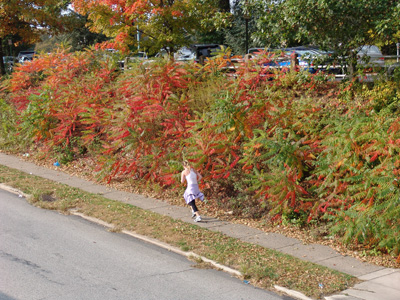
When autumn comes to mind, one conjures up images of rich hues of red, orange, and yellow. There are countless species that have appreciable fall color, and the Scott Arboretum is full of examples. Right now there are several species on campus with spectacular fall color, some of my favorites being the American smoketree, Cotinus obovatus, the sourwood, Oxydendrum arboreum, the black gum, Nyssa sylvatica, and the Fothergilla gardenii. Then there is the staghorn sumac, Rhus typhina clump along Chester Road, which I find to be quite exquisite.
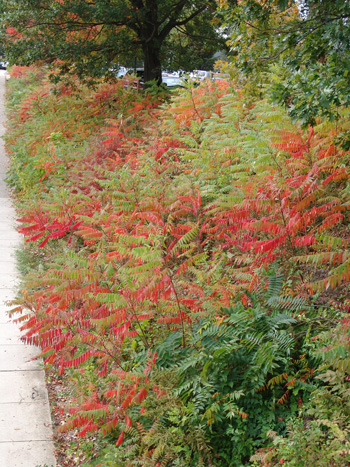
Rhus typhina along Chester Road. photo credit: S. Keitch
Personally, nothing signals the changing seasons like driving past a fiery clump of sumacs on the highway. Of course, these are not always deliberately planted, but are nonetheless, some of my favorite colors. I think of many things as the unruly scarlet foliage passes by, one of these being adversity. Many of us could learn some valuable lessons from this “pioneer” plant. It takes a bad situation, when everything is damaged and nothing else is growing, and transforms it into something ideal. The rugged old Sumac is a great indicator of things to come in the process of forest succession.
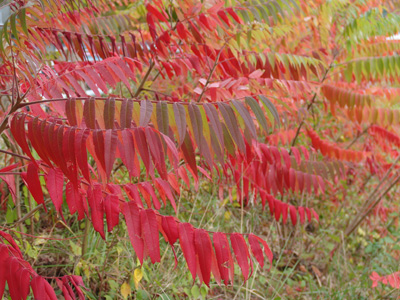
Bold foliage of Rhus typhina. photo credit: S. Keitch
On the other hand, you can also simply admire the plant for its bold features. The compound foliage creates an almost tropical effect, with several species and their cultivars offering a variety of patterns. White plumes appear in summer then turn to clusters of fuzzy red fruits that persist through the winter. Then there is the notorious growth habit. I like chaotic forms and things of a wild nature, and the sumacs all have such rambunctious character that it is hard not to admire their tenacity. You can plant them in one bed, and they’ll pop up in another!
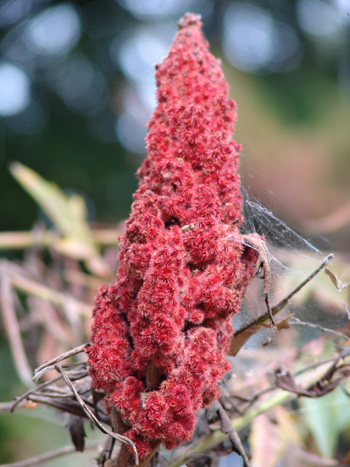
Clusters of fuzzy red fruits of Rhus typhina. photo credit: S. Keitch
Staghorn sumacs can colonize an area by sending up aggressive suckers, which slowly radiate outward to create an open crown. This is not something a meticulous gardener would appreciate, but it is quite entertaining. Another rewarding practice is to heavily cut back a sumac to rejuvenate its appearance. I highly recommend showing a Sumac some tough love, because it will keep coming back for more.