
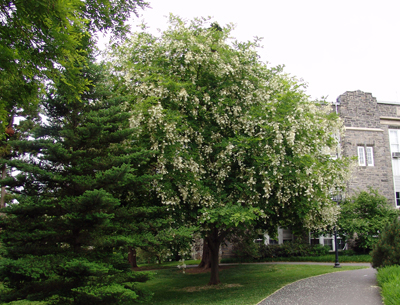
It is dubious to make a claim that something is your favorite plant, but when someone asks me what my favorite native tree is, I can narrow it down to a few. At the top of that short list is the American yellowwood, Cladrastis kentukea. I have the tendency to point out a plant every five minutes and claim that it is my new favorite, so when I have a definitive answer, it is after great consideration. Without hesitation, I can say that the Yellowwood is my favorite native tree. Right now there are several large ones putting on a spectacular show at the Scott Arboretum.
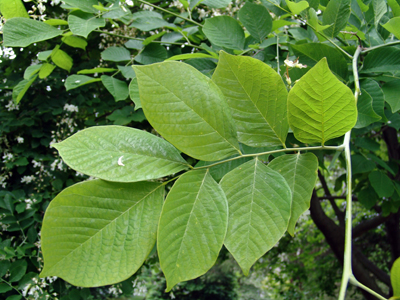
Leaf of Cladrastis kentukea. photo credit: S. Keitch
The common name is self explanatory, as the vascular system produces yellow wood. The range of the yellowwood is not a contiguous expanse as many trees of the Appalachia are, but consists of small endemic regions that are located sporadically from the southeastern United States into the Midwest. The foliage is very handsome, with each compound leaf reaching about one foot long and consisting of leaflets that are roughly four inches each. This is not only creates a stunning texture, but provides a nice backdrop for the graceful white inflorescences that resemble pendulous wisteria flowers. The white flowers reach a foot in length and are typical of the pea family. Currently they are falling all over the Terry Shane garden, creating the impression that there was a light dusting of snow overnight. The foliage also turns a rich yellow in autumn, and the steel grey bark, much like a beech tree, carries the specie’s ornamental appeal well into the winter.
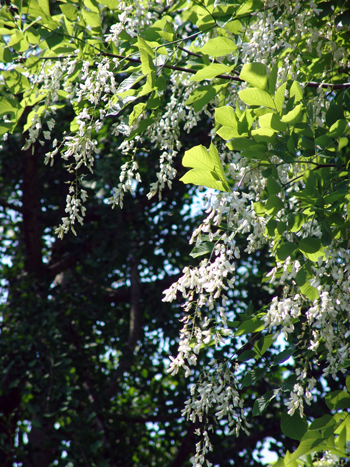
Flowering Cladrastis kentukea. photo credit:S. Keitch
Personally, I think the versatility of the yellowwood may be its strongest attribute. It can tolerate sun or shade, acidic or alkaline soil, and even compact or saturated conditions. However, it will grow more slowly when it has to overcome adverse conditions. Its optimum culture would include rich, well drained soil, with rapid growth being encouraged by shade. An interesting yet unfortunate trait of the yellowwood is its likehood of splitting apart at the crotch of the tree. After forty years or so, unpruned trees will eventually reach a threshold of pressure at their lower crotch, where all of the major limbs come together. In a tree’s juvenile period, leads may be thinned out in order to alleviate pressure to extend its life expectancy.
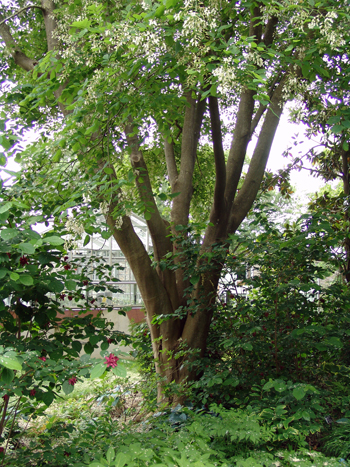
A view of the trunk of Cladrastis kentukea. photo credit: S. Keitch
This is such a promising tree that I would recommend it to anyone looking for an addition to their property. In fact, everyone should plant one. Please come to the Scott Arboretum for inspiration! Once you are here, you will see yellowwoods all over the arboretum, in all of their glory. Large specimens can be found in near the Wister Center, the Nason Garden, and Parrish Hall.