
Guest Author: Olivia Colangelo, 2025 Summer Horticulture Intern
I know as plant enthusiasts we all get excited about those early-blooming flowers. It is a sure sign that spring is on its way; plants will soon wake from their slumber and offer us beautiful blooms in all shapes and sizes. Those first blooms bring with them an air of excitement. Seeing the first snowdrops (Galanthus spp.) blooming makes me excited to start planning out my garden. However, as we keep moving through the motions of spring and summer, these first blooms die out. As we are now some time into August, where can we find the same excitement to carry us into fall?
As you walk around Scott Arboretum & Gardens, the answer is apparent in big, full blossoms – the Hibiscus! These beautiful, showy blooms are sure to give you a late-summer pick-me-up. These Hibiscus plants took their time over spring and most of summer getting their beauty rest, in order to gift us some late-summer stunners. Now that they’re awake and ready to present themselves to the world, let’s give them some proper recognition.
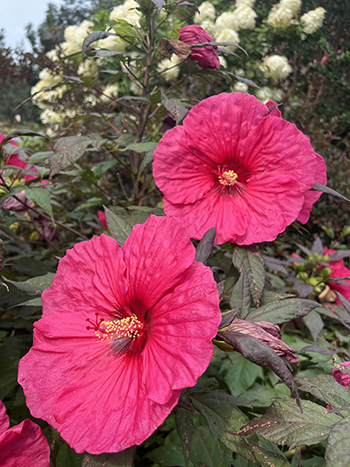
Hibiscus ‘Candy Crush’ – rose mallow
While I’ve seen some incredible flowers here at Scott Arboretum & Gardens, this particular Hibiscus may just “crush” the competition. Hibiscus ‘Candy Crush’ is currently sporting its large, vivid, pink flowers. These blooms are quite a sight to see, as they can reach up to 8 inches in diameter. The larger-than-life flowers have electric pink petals that gradients into a dark burgundy center. As if this plant couldn’t seem more visually appealing, it also has beautifully colored foliage. The bright, reddish-pink flower contrasts with the dark-green foliage to create a striking bush for any garden space.
This cultivar is considered low-maintenance and if given a nice, sunny location with moist soil, it will gladly gift you with giant blossoms. It is also hardy and will do well in Zones 4-9, making it a great garden plant for our area. Just be mindful that they are slow to leaf out in the spring and won’t start looking lively again until the weather is nice and warm. This rose mallow is not a fan of the cold, so it will stay in hiding until it is absolutely sure that there is no chance of frost. Make sure to be patient with this rose mallow, as it is simply gearing up to give you some excitement towards the end of summer. Our Hibiscus ‘Candy Crush’ is located in the Terry Shane Teaching Garden right against College Avenue. You won’t regret taking the time to see these magnificent Hibiscus blooms for yourself.
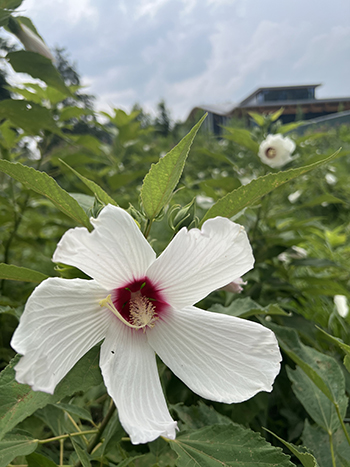
Hibiscus moscheutos – swamp mallow
The stormwater basin to the east of the Dining & Community Commons is truly a must-see attraction at the moment. This stretch of marshy land holds a massive collection of Hibiscus moscheutos, which are all opening up their beautiful white blooms. The basin is full of tall stalks, each holding many flowers. These stalks can be anywhere from 3-7 feet tall. The area looks like a sea of white flowers at the moment, and is worth a visit.
One of its common names is “crimson-eyed rosemallow” which is certainly a fitting name. The large, white blooms fade into a deep-purple center, which creates a beautiful effect when there are so many blooms in a small area. The blooms themselves are fast fading and will only last a day or two. However, the plant replenishes its buds quickly and is constantly putting out new ones. This allows them to be a constant source of beauty in gardens well into the fall and even up until the first frost. Swamp mallows are rightfully named, since they enjoy keeping their roots in moist soil that never completely dries out. This makes them a perfect plant to use in floodplains, rain gardens, or marshy areas. Luckily, these swamp mallows have found their perfect home here on campus, as this area stays consistently moist with its collection of rainwater. Make sure to come see this spectacular gathering of swamp mallows. However, if you’re planning on getting up close and personal, make sure to wear your wellies!
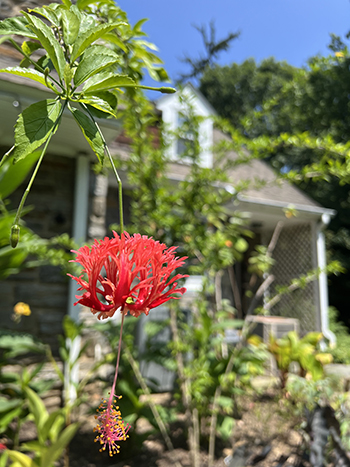
Hibiscus schizopetalus – fringed rose mallow
It is no wonder that this plant caught my eye, as my first interaction with it was being whacked in the face by its long, pliable branch. The Hibiscus schizopetalus is rather unique in its shape and blooms, and you might not even recognize it as a Hibiscus at first. This Hibiscus is known for its arching branches, which grow upwards and then bow downwards, facing away from the center of the plant. The plant itself reaches up to 8 feet, and the spread of its tendril-like branches can reach out around 6 feet. As the branches mature and start arching downward, they will produce a rather unique orangey-pink lantern-shaped bloom, usually found on the end of the branch. The fringed rose mallow’s blooms are very unique compared to the classic round Hibiscus shape. This plant’s blooms are a hanging ball of fringed petals, with the stamens being long pendants that hang down. The branches and blooms create a beautiful shape, but you do have to be mindful about how much space they take up. As I was planting this fringed rose mallow into the garden bed at the Dan West Garden, I was constantly trying, and failing, not to be hit in the face by these long, weeping branches. Though the bright, dangling flowers surely make this particular plant worth any trouble.
While this plant is technically not a “late bloomer” like the other two hardy mallows, it is in bloom now and can continue to put out new blooms if the weather stays warm. As you know, our fall weather has gotten less severe over the years. This means the fringed rose mallow can continue to send out its lantern-like blooms well into fall. However, this Hibiscus is not winter hardy and will not appreciate being left out in the cold. It will need to be brought inside once the evening temperatures start dropping into the low 50s. These chandelier-esque blooms are certainly worth the walk up to the Dan West House. The pendulous blooms give off a magical feeling, especially when they sway in the wind.