
Guest Author: Zoe James, 2025 Summer Horticulture Intern
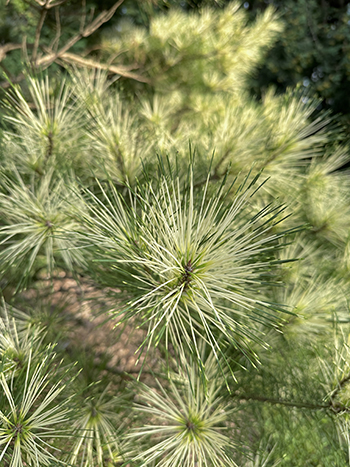
Pinus densiflora ‘Burke’s Red Variegated’ – Japanese red pine
One of the most captivating sights in the Pinetum this summer is Pinus densiflora ‘Burke’s Red Variegated’. Before I saw it here, I didn’t even realize that conifers could be variegated. This Japanese red pine was planted in 2021 and struggled a bit in its first couple of seasons, adjusting to its new home. But this year, it has come back with vigor, putting on lush new growth and showing off its unique foliage in full glory.
From a distance, the whole tree seems illuminated and glows on its own. When you get up close, you notice that each needle is banded in stripes of creamy white, and looks like quills of a porcupine. In the early morning or late afternoon, when the low sun filters through the branches, the effect is especially magical.
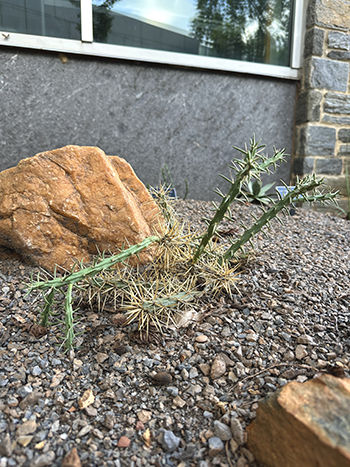
Cylindropunita davisii ‘Sun Spike’ – Davis cholla
Just outside the Science Center, you will find a little surprise – a collection of cacti thriving far from their desert homes. One of the stars of this unexpected planting is Cylindropuntia davisii ‘Sun Spike’, a species native to the grasslands and oak-juniper-mesquite woodlands of New Mexico, Oklahoma, and Texas. While cacti may not be the first plants you associate with the arboretum, this display proves that with the right conditions and a bit of horticultural curiosity, plants from vastly different habitats can survive in new places!
Its spines are 1.5 to 5 cm long, and start out a pale green on fresh growth, maturing to a creamy, bright white. These spines are actually modified leaf tissue, serving as both protection and a way to reduce water loss. In the right light, these spines catch the sun like glass fibers, glowing softly against the blue-green stems.
The cholla here are part of a trial garden curated by Sandra Lopez Cortez, who sourced them from a nursery in North Carolina, where they are known to be hardy. The goal of this project is to see how these “zone busters” handle our climate without any winter protection. As winters become milder, plants like these might find a permanent place in our gardens in this area. For now, their survival through a full cycle of seasons remains an open question, so this summer is the perfect time to visit and see them in peak form!
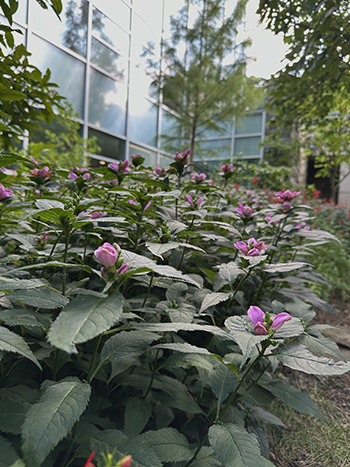
Chelone lyonii ‘Armtipp02’ – Tiny Tortuga™ turtlehead
As my summer season at the Scott Arboretum winds down, one of the last plants to begin its floral show is Chelone lyonii ‘Armtipp02,’ affectionately known as Tiny Tortuga™ turtlehead. Nestled in the Glade Garden next to bright red cardinal flowers (Lobelia cardinalis), this native perennial is a gem for shady, moist spots.
A more compact cultivar than the straight species, Tiny Tortuga™ reaches a manageable height that makes it perfect for small garden spaces or the front of a border. Its glossy, dark green foliage forms a neat mound that stays attractive all season. Just when many summer perennials start to fade for the season, it sends up spikes of bright pink, turtlehead-shaped flowers that bloom from late summer into October. It is also naturally deer resistant! Its tolerance for shade and preference for moist soil make it a lovely addition for any shade or rain garden.