
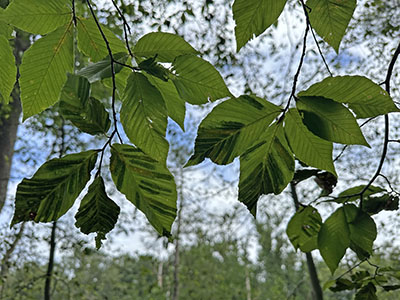
The newest emerging disease affecting shade trees, Beech Leaf Disease, is spreading across the Northeastern states and it is on campus. This disease affects American beech, European beech, and Oriental beech. It is currently having a devastating effect on the predominant beech/birch/maple forest in New York state and has been present in Massachusetts since 2020.
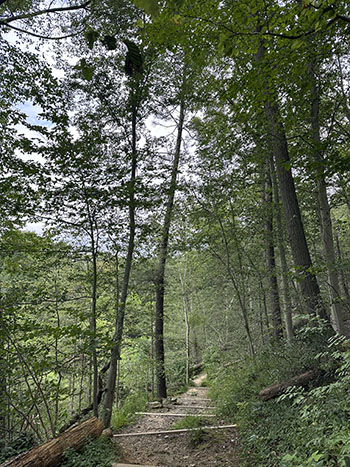
Symptoms include leaf striping, curling, and leathery texture. These symptoms can be observed from May to October by looking up into the canopy. Microscopic worms, known as nematodes, feed on plant foliage, affecting the leaf tissue and photosynthetic process, which in turn weakens the tree. As the disease progresses, leaf and bud production is impacted along with heavy leaf loss. A single tree can have heavily infected branches and unaffected branches.
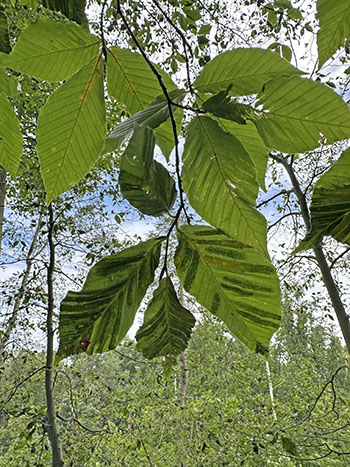
The beech genus, Fagus, lacks any natural defenses to this disease. The two options for treatment are foliar sprays and trunk injections. Foliar sprays are typically for young specimens while mature, large specimens require a trunk injection. Many homeowners are choosing to protect their large, mature specimens with these treatments.
Here at Scott, we are proactively treating approximately 30 specimen trees in the heart of campus, where we are seeing little to no symptoms at this time.
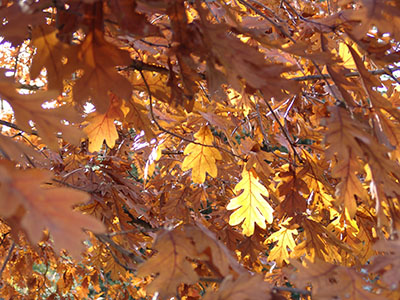
Unfortunately, our predominantly maple/beech forest along the Crum Creek is extensively affected. We are letting nature take its course in the woods and are developing plans to replant the beech-dominated areas with native trees. We plan to use a selection of white oaks (Quercus alba), hickories (Carya spp.), and maples (Acer rubrum), and also allow our tulip poplars (Liriodendron tulipifera) to seed in. In the understory, we are planting redbud (Cercis sp.), chokeberry (Aronia sp.), and native dogwood (Cornus florida).