
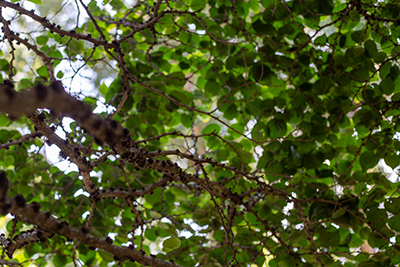
Cercis chinensis ‘Don Egolf’ – Chinese redbud
Redbuds have exciting Cercis genus features. From their cordate leaves to their luminous spring flowers that cover the branches, each redbud has something to offer. Nestled between the tree peony beds, the Cercis chinensis ‘Don Egolf’ has its own unique flair. On this particular tree, the long-dead flowers have found new life as burly smatterings along the bark. Clusters of browned, senescing flowers grip the branches like gnarly bark whorls or parasitic, infested outgrowths of some kind. They add an eye-catching thrill to this lovely tree.
Native to woodlands and thickets of southern China, this tree grows more shrubbily in our own ornamental collections. Compared to our own native C. canadensis (eastern redbud), C. chinensis ‘Don Egolf’ has larger spring blooms and a shorter stature. The Chinese redbud’s leaves have a glossier shine, but the fall color tends to be less exciting, peaking at a wilting yellow-brown before dropping. This particular cultivar is notably sterile, and doesn’t produce the long seedpods of the standard C. chinensis.
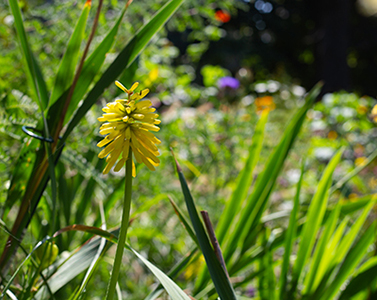
Kniphofia ‘Gold Rush’ – red hot poker
When this flower first began blooming in the Cut Flower Display Garden behind the Wister Center, I wasn’t even convinced it was a flower or an inflorescence. Instead, its tubular-shaped blooms emulate tiny, cartoonish conifers. These drooping flowers open their petals in midsummer when other flowers might be looking scorched or tired, and they offer a unique point of interest for any flower fan.
This cultivar ‘Gold Rush’ isn’t your typical red hot poker. For one, it’s not red. In our gardens, Kniphofia ‘Gold Rush’ has greener and yellower hues than many of the genus originating in South Africa. This cultivar is also tested for winter hardiness down to Zone 6, and could likely withstand harsher winters given the proper mulching and protection. In most cases, these flowers want full-sun, but tucked under one of our magnolias, these pokers come back happily each summer.
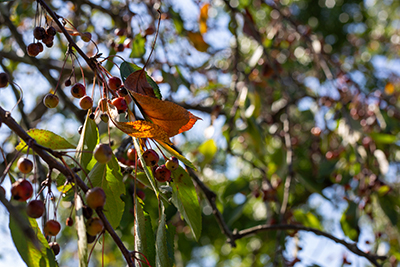
Malus x scheideckeri ‘Red Jade’ – flowering crabapple
One of the final trees standing from the previous crabapple collection, this unassuming Malus x scheideckeri ‘Red Jade’ brings hints of the coming fall even early in September. Its delightful red fruits sprinkle amidst its multicolor leaves, already in the process of shifting to an autumnal mindset. Where other trees in the area display giant leaves or coniferous shade, this tree has a vibrant glow in an unsuspecting pocket of the Arboretum. Between the Cunningham parking lot and the tennis courts, one might not expect much in the way of tree collections, but this gem brings excitement and pizzazz through its color and unwieldy habit.
This particular crabapple is a hybrid of M. floribunda (Japanese flowering crabapple), and M. prunifolia (Chinese crabapple). Hybridization across species is common in crabapples, and it can be difficult to identify the naturalized species outside of ornamental environments. For this particular cross, the leaves have slightly serrated margins, and the trees produce delicate, white flowers in the spring. The ‘Red Jade’ cultivar weeps its branches, creating a low umbrella, excellent for catching as much of the full sun as it can.
They’re also notoriously disease-ridden. Among the major issues is fireblight. This disease wrecks Malus plants across the genus, hindering apple production across the country. In the spring, once the temperature breaks 65°F, the fireblight bacterium can infect a tree, typically entering through damaged and wounded parts of the tree, and kill entire blossoms, fruits, shoots, and branches in the process. Unfortunately, these diseases also love the warmth and humidity of this region, and the bacteria easily spreads with rainfall. These trees also suffer from scab, powdery mildew, and leaf spot on occasion. In general, prune this tree during the late winter months, not the spring, to reduce likelihood of acquiring a disease.