
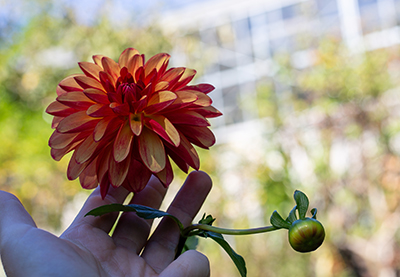
Whether you propagate them every year or the extent of your knowledge is the true crime case from the ‘40s, this week we’re doing a deep dive on dahlias. In our gardens, these warm-weather perennials leave their lingering radiance even as many of the other late summer blooming flowers have started to phone it in for fall.
Dahlia is a genus of plants native to Central America, Mexico, and Colombia now teeming with crosses and cultivars. The plant gets its name from Andreas Dahl, a Swedish botanist and student of Carl Linnaeus. When European colonizers first encountered the wild species, Dahlia pinnata consisted of only a single flower head with a scarlet ray and yellow disk. With over 20,000 recorded cultivars in its over 400 years of European horticultural significance, Dahlia is a genus where you can find a surplus of colors, shapes, and sizes. These plants fall under the Asteraceae family, and like the many other plants similarly categorized, Dahlia have capitulum, deceptive head inflorescences where each petal consists of its own floret. A bunch of florets unite to form a single, flower-looking inflorescence. Dahlia distinguishes itself by rapidly growing tall, erect stems and being a pain to cultivate.
Before Spanish conquest in the 16th century, this flower held little cultural significance for the Aztecs and other indigenous populations of the region. Some sources will attribute Dahlia to the Aztec war god Uitzilopochtli, but The American Dahlia Society has published rebuttals to these claims.
One of the first potential identifications of Dahlia could come from the Badianus Manuscript. This text was a dusty, forgotten herbal compendium tucked into the corners of the Vatican library, originally published in 1552 but only recently rediscovered in the 1930s. Between the lapsed time and the rampant destruction of Aztec religious materials during Spanish conquest, fact-checking this document proves to be an archaeological challenge. An illustration in this compendium depicts a red flower with a yellow center and thin, spindly stems – potentially Dahlia pinnata or a similar species. The Aztecs also weren’t known for their flower gardens, mainly confining their non-agricultural blooms to Tithonia, Tagetes, Zinnia, and Cosmos species for ceremonies. Dahlia popularity took off once Europeans repeated their track record of importing warm weather plants to their colder-climate gardens and hoping for the best. And in 1963 dahlias were named Mexico’s national flower.
In the Nahuatl language, its original name acocoxochitl literally translates to “water gullet plant,” and true to form, these plants love water. But only at certain points in their life cycle. Growing dahlias is not for the faint of heart. From seed, these plants need to start indoors for 8-10 weeks or just barely covered with topsoil outside 1-2 weeks before the last frost. Germination time ranges from 5 to 20 days, and they’ll need to each occupy their own pot. Plants can then be transplanted only once risk of frost has dissipated (recommended: 4 weeks after the last frost). You’ll need a spot in your garden with access to full-sun or afternoon sun and enriched soil, but too much nitrogen results in leggy plants. Before flowering, Dahlia only need water during very dry weather, but once the flowers bloom, the soil needs soaking at least once a week. Throughout the blooming season, deadhead your flowers to stimulate growth and prevent senescence.
You can collect the seeds for a Dahlia surprise the following summer, but to ensure you have the same cultivar, divide Dahlia tubers in the fall or the spring. You’ll need to lift the tubers once all of the foliage has died, placing them in pots with soil, and keeping them just barely moist in a cool, dry, frost-free location to wait out the winter. An easy task for anyone living in an older building! Once you’re ready for division (either in the fall or spring), break up the tubers so each division ends in a stem and has several eyes. Pot the dahlias with the eyes facing upwards, each in its own container. To begin stimulating growth again, keep the divided tubers in a warm spot with moderately damp soil, and begin fertilizing with half-strength liquid fertilizer once per week. Don’t transplant the plants until you know the plants won’t get zapped by frost. If you see new shoots, and the last frost is a forgotten memory, your plants are ready for their new summer home in the garden.
Growing dahlias in the mid-Atlantic takes perseverance, dedication, and lots of water, but it isn’t impossible. If you’re up for the challenge and prepped with a sunny garden location, Dahlia might be the right plant for you.
In the book A Contemplation Upon Flowers: Garden Plants in Myth and Literature by Bobby J. Ward, the author states, “In the language of flowers, a single dahlia indicated good taste, but a collection noted instability, apparently referring to the difficulty of growing it in cooler European gardens.” At the risk of appearing unstable, here are three Dahlia cultivars worth exploring at the Scott Arboretum & Gardens.
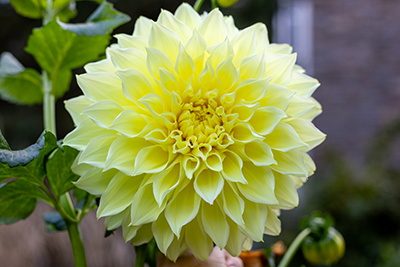
Dahlia ‘Kelvin Floodlight’
Every other week, without fail, one of the Scott Associates highlights this dahlia for a floral arrangement. It’s a beacon in the garden. Even during a rare rainstorm while casually weeding through the Cut Flower Display Garden, a visitor stopped to ask me about Dahlia ‘Kelvin Floodlight’. One of the earliest blooming of the dahlias in our collection, Dahlia ‘Kelvin Floodlight’ siren-calls passerby with its massive, mesmerizing flower head from its towering stalks. Each petal meticulously strokes pale yellow like a radiant beam, casting a haunting lighthouse appearance at dawn and dusk.
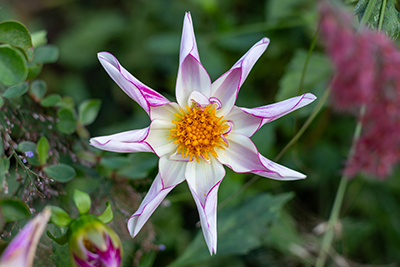
Dahlia ‘Willie Willie’
Dahlia ‘Willie Willie’ tests the boundaries of the cultivation possibilities for dahlias. Where many flowers have a unified, circular appearance, ‘Willie Willie’ rejects conformity. Each petal wraps itself in a blanket of its own magenta-outlined design, forming a unique shape with each self-ensconced petal. Amidst the eclecticism of the Asteraceae family, Dahlia ‘Willie Willie’ exudes originality – if you don’t mind crouching low in the Cut Flower Display Garden to look for it. And besides. You cannot go wrong with a name like ‘Willie Willie’.
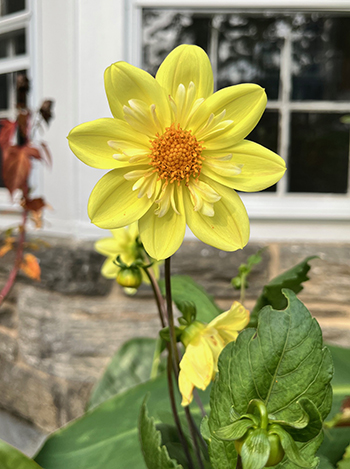
Dahlia ‘Kelsey Sunshine’
While most of our dahlias live in the Cut Flower Display Garden, the summer interns managed to sneak up one of the unplanted few from the arboretum collection to plant up at the West Garden. Amidst the enthusiastic chaos of the tropical bed, this sweet Dahlia ‘Kelsey Sunshine’ continues to shoot out new blooms into the ether. Refusing to be wrangled into a normal configuration, the stems have curved and swerved amidst the Acalypha. Its blooms and curving stems more closely resemble the Badianus Manuscript depictions in egg yolk yellow.