
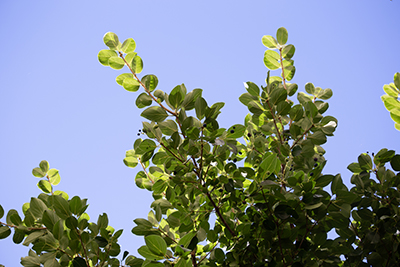
Chionanthus retusus ‘China Snow’ – Chinese fringetree
My first encounter with Chionanthus retusus happened when I was painting “Little Princess” pink with the other summer interns. The dead, pink tree and the collaterally splattered tree beside it are both Chinese fringetrees, enjoying a beautiful spreading habit but otherwise not drawing much attention during the peak summer season. These trees glisten with swaths of fragrant, white flowers in the spring. Unlike the native species C. virginicus (white fringetree), the flowers blossom at the terminal end of spring new growth and not before leaves emerge, swathing the green leaves in a white cloak. However, I wasn’t drawn to these flowers I have yet to truly appreciate but rather the charming blue fruits. Paired with the rotund, little leaves, the underside of an autumnal Chionanthis retusus feels like a sweet gift from nature.
Chionanthus retusus ‘China Snow’ rests on the hillside behind Beardsley Hall and overlooks the quad in front of Martin Hall. Tucked beside the building and slightly above eye-level, the shade feels like a hideaway in plain sight to enjoy the comings and goings of campus life. Nestled close, the deeply ridged bark also shares its company, rough but joyfully distinct, traceable, and crackling with rivulets. Throughout the autumn, this tree might develop a gentle, fall yellow as it often does in Northern latitudes. In the spring, I hope to return for the delightful show of snowy white flowers as it often produces. The gardens burst with delicious treasures year-round.
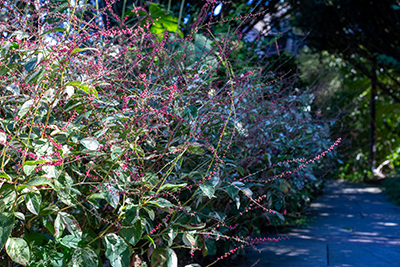
Persicaria virginiana ‘Painter’s Palette’ – knotweed
The Arboretum Entrance Garden is riddled with mischievous jumpseed plants (Persicaria virginiana). Although native, the spritely spikes of plants tend to seed in and pop up no matter the back-bending weeding attempts. The flowers easily self-seed, and when poked, these seeds spring across the garden, alighting around the garden. P. virginiana also readily resists removal. This native perennial grows in clumps from its spreading rhizomes and develops tough root systems. Mostly sticking to shaded woodlands and moist environments, these pesky plants litter the Crum Woods walkways and offer a jubilant texture in their native spaces. However, for all their embedded and puckish nature in the gardens, the ‘Painter’s Palette’ cultivar has found a home here.
Persicaria virginiana ‘Painter’s Palette’ has all the fun characteristics of the original species with an additional sprinkle of color. The leaves contain a mottled variegation with shades of white and green bisected by a dark, maroon chevron pattern that fades throughout the summer. The spikes of petite flowers are a shock of hot pink where they spring up. In the shaded pathways snaking through the Arboretum Entrance Garden, these plants catch eyes and earn their striking cultivar name. For that reason, Persicaria virginiana ‘Painter’s Palette’ succeeds where its non-cultivated counterpart struggles to find its place in a colorfully maintained garden.
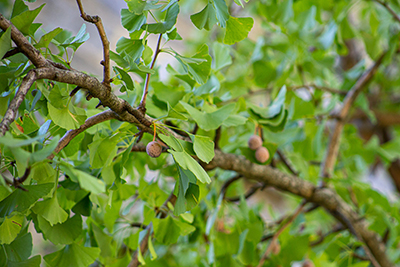
Ginkgo biloba – maidenhair tree
When it comes to Ginkgo biloba trees, what you see is pretty much what you get. Being gymnosperms, they don’t have flowers, and not being conifers, they don’t have distinct or unique cones. The leaves turn a delicious, shining yellow later in the fall, but even then, there are few cultivars bred for their carotenoids, mainly focusing instead on producing non-fruiting male trees and variable stem or leaf forms. A Korean international student asked me to point out a Ginkgo tree, knowing the trees are native to her home country. When she saw this tree, she chuckled. “Oh, those. We have those trees everywhere.” And yet they are so singularly majestic, especially at their magnitude around the arboretum.
From street-level, the similarities to its common-name namesake Adiantum pedatum (maidenhair fern) become apparent, with its fan-like leaves finely separated by dark stems and bark. These trees are often found lining streets as they can easily withstand a wide range of soil conditions, salinity, pollution, and other urban challenges. However, there’s a catch. These dioecious trees have separate male and female plants, but you’ll only ever encounter male trees planted in urban environments. The female Ginkgo biloba trees have stinky, messy, fruit-like cones that litter the sidewalks with their acrid odor in the autumn. The seed coats on Ginkgo biloba cones stock up on butyric acid: the same chemical found in rancid butter or vomit. Yum! Right now is actually the perfect time to smell the stinky Ginkgo trees yourself. In our arboretum, you can catch a whiff from the many crushed cone carcasses on the sidewalks at the North Entrance of campus.
Ginkgo biloba is possibly a superhero in plant form. These ancient trees are known for being the last species of a tree genus that populated the planet over 150 million years ago. Originating during the Paleozoic Era, this tree species has withstood two mass extinction events. Many of the Ginkgo trees growing in Hiroshima also managed to survive a direct nuclear bombing: The leaves were singed but the trees were otherwise unscathed. Currently, the oldest living Ginkgo biloba tree is estimated to be 1400 years old, and the oldest ever recorded Ginkgo biloba is upwards of 3500 years old. These trees can also notoriously change their sex from male to female, likely allowing for greater numbers to produce more seeds and keep the gene pool active. It’s a tree adapted for anything.