
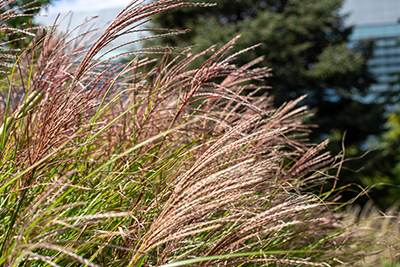
Miscanthus sinensis ‘Morning Light’ – maiden grass
Miscanthus sinensis ‘Morning Light’ is currently soaking up the last of the sun. Throughout the summer, this tall grass has been a personal favorite. Each proud, arching blade encourages its company to brush through its foliage, delighting in the gentle swishes under your hands. And it gets better. Now in the John W. Nason garden, the blooming panicles on the Miscanthus sinensis ‘Morning Light’ glow with their auburn beauty where they flutter above the greenery. Later, these blooms will puff into fluffy white clouds for further excitement. Growing up in the suburbs of Chicago, we would trick-or-treat in the snow with our winter gloves on. I’m a little shocked to see some flowers still hanging on this late in the season, but there’s always something blooming around here – even if it’s grass.
Maiden grass typically sheets fields in eastern Asia or, in the case of the United States, disturbed areas and roadsides. The wild type can be a fairly weedy plant that seeds vigorously. ‘Morning Light,’ first introduced by Japanese plant specialist Masato Yokoi in 1976, doesn’t produce viable seeds, containing its potential for invasiveness. These lovely grasses catch fire quickly, as well, and any brave gardener to try them should be sure to plant Miscanthus sinensis a fair distance from their house. Maiden grass grows fairly easily anywhere with sun, and it only needs to be cut back in early spring when new growth starts shooting.
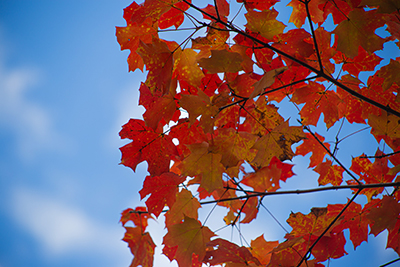
Acer saccharum ‘Morton’ – Crescendo™ sugar maple
More familiarly exciting as the fall really hits your wardrobe and sinuses, the sugar maples have finally set alight. Acer saccharum [Crescendo™] ‘Morton’ is just one fiery example of this delightful species. On these trees, you can easily see the leaves changing color, from the way each leaf slowly loses its chlorophyll pigments in a gradient away from the sun. A whole palette of anthocyanins, carotenoids, and xanthophylls bleed into each branch. Nothing quite says fall like an Acer saccharum.
I’m particularly partial to this cultivar because we’re both transplants from the same area of Illinois; I once lived a spitting distance from Morton Arboretum. This cultivar was bred for its drought tolerance and heat resistance, making it perhaps more suited for the Philadelphia environment than some of its wild counterparts. Despite being grown frequently as a street tree, A. saccharum doesn’t typically fare well with compaction and pollution. It’s best suited for slightly acidic, moist soils in full sun, but it notoriously beats out competition in forested environments with its shade tolerance. The leaves have quickly fallen and blanketed the grass, though, so you’ll want to scamper up to the north side of campus if you want to catch them before only bark remains.
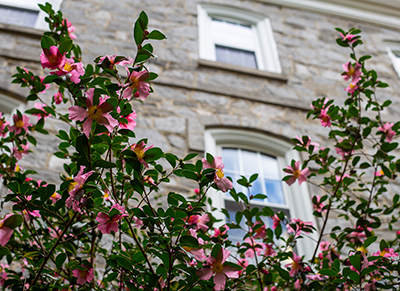
Camellia ‘Winter’s Star’ – camellia
I’ll admit I wasn’t quite taken with camellias, but their floppy petals and sweet, unplaceable fragrance reluctantly piqued my fancy as leaf color and bark categorize the rest of the late autumn season. Snaked with a small grass pathway, Scott Arboretum & Gardens boasts a couple Camellia plants behind Parrish Hall. The lovely pink ‘Winter’s Star’ cultivar flirts its colorful branches up against the building, daring passersby to catch their own whiff of light jasmine tones. This flowering shrub might fit best in a protected garden that can shield the plants from cold wind and too much direct sunlight. These plants also prefer soils that can get moist but drain easily and have high soil organic matter, and establish best when planted in spring rather than autumn. Camellia can be a bit fussy, but it otherwise handles our climates in the mid-Atlantic well.