
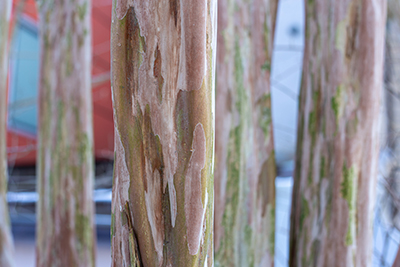
Lagerstroemia ‘Natchez’ – hybrid crapemyrtle
For the brave adventurers who have explored the Scott Arboretum & Gardens in the winter, there’s lots to see. Mainly bark. However this new perspective on plants allows the casual viewer to really develop an appreciation for the distinctions between barks. Lagerstroemia ‘Natchez’ has a particularly unique appearance. The pinks and greens meld and overlap like a springtime camouflage.
Towards the end of the summer, this plant will produce white panicles of flowers. These blooms earned Lagerstroemia the moniker “Lilac of the South.” Often grown in multi-stemmed clusters, this hybrid crapemyrtle can sometimes sprout as a single-stemmed small tree in warmer climates. Between the bark, flowers, and luscious green leaves, this plant is a year-round spectacle.
Plenty of crapemyrtles have unique bark colors and designs. ‘Natchez’ stood out to me by the stark contrast of these hues. Originally a cross between L. indica and L. fauriei, ‘Natchez’ is one of several mildew-resistant hybrids developed by the National Arboretum. The Arboretum named each hybrid’s cultivar after a Native American tribe. Lagerstroemia ‘Natchez’ produces the best flowers in full sun, planted in acidic loams or slightly clayey soils.
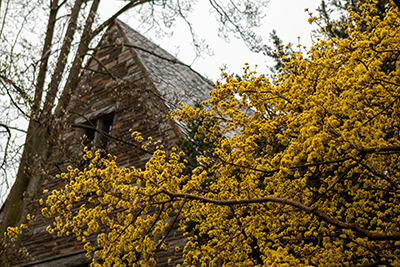
Cornus mas ‘Spring Glow’ – corneliancherry dogwood
This week’s late winter storms featured grey skies and cold winds. This corneliancherry dogwood in front of Bond Hall called to me as a shining beacon against the final dreary weeks of winter. Around the gardens, some flowers have begun to peek their heads up from the newly-mulched beds, but Cornus mas ‘Spring Glow’ stands a head above the rest. Or maybe closer to a couple heads. These bright, puffy, mustard-yellow, pompom-like inflorescences reflect every photon of light that breaks the cloudcover. They also contrast the morose, purple blooms and leaves on the Helleborus x hybridus ‘Black Diamond’ flowers below. The collective image of early spring delight has even encouraged a few cautiously optimistic bees.
Beyond the sunny flowers, this tree also has notable bark. The mottled, dusty browns layer against a rosy undertone, and strips crackle and fray around the bends and corners. In the late summertime, the bright red fruits will speckle the branches in a similarly vibrant fashion. They’re completely edible and definitely worth a try, but maybe have a glass of water on hand.
Depending on the sun and soil quality, Cornus mas ‘Spring Glow’ only maxes out around 25 feet. Find a sunnier spot to promote better blooming, and keep to moist, well-drained soils if possible. This small, flowering tree can withstand a variety of urban conditions, and it’s moderately drought tolerant. With the right garden space, this show-stopping shrub could provide year-round excitement and breathe life into the late winter garden.
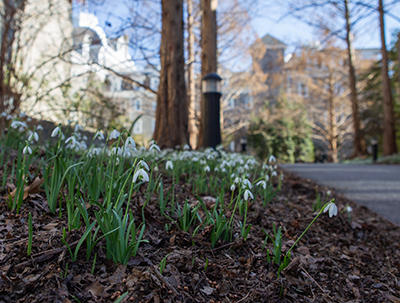
Galanthus nivalis – snowdrop
Tis’ the season of the snowdrops. Just as the snow officially melted, these tiny white flowers sprung their own white blanket on the forest floor of the Metasequoia Allée. In the foggy dusk light, these flowers glow eerily like tiny flower ghosts.
Like many of our bulbs, this flower is native to Europe and southwest Asia, having naturalized in some areas of North America. In some gardens around the Cunningham House, staff on our horticulture teams have had to spend hours digging their fragile stalks out from under piles of leaf debris left over from the previous fall. They’re not accustomed to our teeming oak organic matter. The little white wisps have nonetheless livened the post-snow gardens like tiny harbingers of spring. Whether or not the false spring has fooled them, I’m delighted by this glimpse of the gardens to come.
Galanthus nivalis features six tepals rather than any true petals: three milky white tepals on the outside and three more enclosed within. Monocots like Galanthus nivalis can be identified by their clusters of three flower parts. Dicots, alternatively, have flower parts in groupings of four or five. The leaf blade is thin and narrow with parallel venation and a rounded tip.This particular species of snowdrop prefers moist, humusy soils. In the summertime, horticulturists frequently water the allée to make sure these perennials planted under the Metasequoia glyptostroboides (dawn redwood) don’t dry out in the drought. We’re also at the lower end of their zone range. Galanthus nivalis struggles south of Zone 7.