
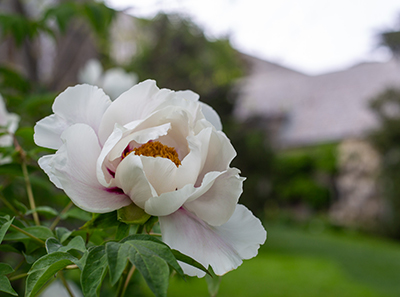
Paeonia (Suffriticosa Group) ‘Ezra Pound’ – tree peony
A gorgeous white flower dancing along the walkway to the Theresa Lang Garden of Fragrance, Paeonia (Suffriticosa Group) ‘Ezra Pound’ rings in the first, early-blooming tree peonies in the Peony Collection. This cultivar originally comes from William “Bill” Gratwick’s collection at Linwood Gardens in the outskirts of Rochester, NY. The flowers are most notable for their delicate, off-white hue, suffused with light pink that seems to bleed from the dark pink markings within the central, ensconced layer of petals.
Dotted along the sloped terrain, tree peonies have started to bloom in the Peony Collection. Paeonia represents more than 30 species, the majority of which are herbaceous perennials. Tree peonies instead develop woody stems into shrubs. As a result, these plants flower before their herbaceous and Itoh hybrid counterparts. Suffriticosa Group peonies refer to cultivars bred using Chinese Paeonia species from the subsection Vaginatae. More commonly these plants are called Moutan peonies. The flowers they produce easily grow to the size of an adult human hand, and a fully-grown, 5-foot tree peony may develop as many as 100 flowers in a single season.
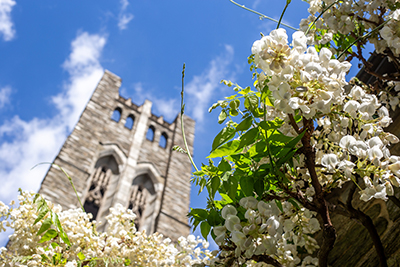
Wisteria brachybotrys f. plena – silky wisteria
Another white flower currently in bloom gracefully drapes from the overhanging arches of the Theresa Lang Garden of Fragrance. Wisteria brachybotrys f. plena dangles its strings of pearly white flowers over the square lawn in front of the Intercultural Center. The curling vine structure combined with the hanging flowers make for a stunning ornamental plant. Up close, you can also get a whiff of its sweet fragrance as it wafts through the garden.
Wisteria plants interact with a number of different organisms to succeed. The plant operates as food for some Lepidoptera species larvae, including several kinds of moths. Wisteria falls under the Fabaceae family as a legume along with peas. As a legume, Wisteria have symbiotic relationships with Rhizobia in the soil that fix nitrogen. Growers therefore don’t need to supplement the soil with nitrogen fertilizers, only potassium and phosphorus. Wisteria brachybotrys originates in Japan, and its species name refers to the “small clusters” of flowers. Although the species isn’t native, it’s not as aggressive as the W. floribunda (Japanese wisteria) and W. sinensis (Chinese wisteria) Asiatic species.
However, there is a native species W. frutescens (American wisteria) that doesn’t take over the local forests. The biggest difference between the plants is that the North American species blooms after the plant has leafed out. Asian Wisteria vines bloom before the foliage opens. W. frutescens can typically be found in the wild along streambanks in the eastern United States. For gardeners, find a space for the plant to either climb or grow into a tree-like form in full-sun with moderate soil conditions. Although W. frutescens doesn’t have the history of cultivation that shaped other Wisteria species for centuries, its lavender-shaded blooms still offer a delightful vining spark to the garden – if you can handle the endless pruning maintenance, that is.
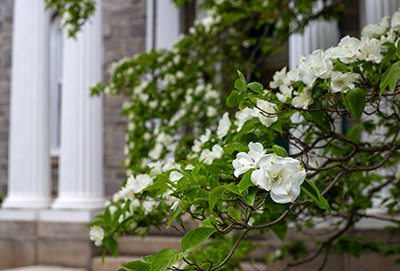
Cornus florida ‘Pluribracteata’ – flowering dogwood
The final white flowering plant of the week isn’t actually a white flower at all. Outside of Parrish Hall, the Cornus florida ‘Pluribracteata’ is in full bloom and covered in creamy white bracts. Unlike flowers and petals, bracts are actually modified leaves. On the flowering dogwoods, these petal-like bracts frame the true yellow inflorescence. The species name florida is also deceptive, meaning “flowery” in Latin. However falsely floriferous these plants are, the white ornamentation on Cornus florida ‘Pluribracteata’ provides a simple elegance to the Parrish Hall walkway. The layers of petal-like bracts gracefully top the leafy branches like sprinkles on a cupcake.
Cornus florida grows best on flatlands or lower on slopes rather than the tops of hills. Their shallow root systems have a difficult time collecting enough water for the plant on these higher, drier locations. Typically Cornus florida can be found in the shaded understory of Pinus taeda (loblolly pine) stands in the South although these trees grow from Ontario to Mexico. They’re an important ecological staple for birds and mammals who feast on the tree’s seeds, fruits, flowers, leaves, and bark. Flowering dogwoods have surprisingly high calcium and fat content. However, their anthropogenic uses tend to lean more towards small wooden tools such as textile shuttles, spools, malletheads, and pulleys.