
Plants of the Week by Kaiden Lytle, Summer Education Intern
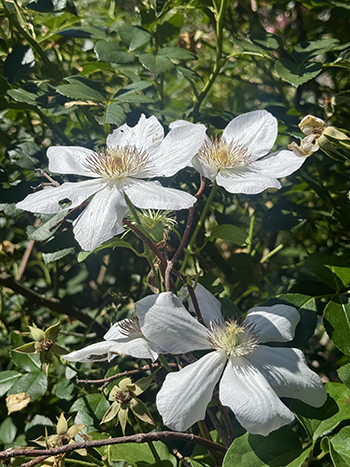
Clematis (Early, large-flowered Group) ‘Jerzy Popiełuszko’ – clematis
Popular for its large white blooms (13-15 cm diameter), this clematis adds a bit of elegance to any garden. This variety is fond of climbing and will climb both living and non-living structures nearby (trellises, fences, shrubs, etc). The leaves of this plant are large as well and are tripartite and heart-shaped. In regard to care, ‘Jerzy Popiełuszko’ prefers sunny sites in USDA Zones 4-9, with well-drained, fertile soils. In these conditions, it will bloom happily from May through October.
This clematis cultivar was originally bred in Poland by Dr. Szczepan Marczyński, and released to the public in 2004. Notably, the following year, it won a gold medal at the 2005 Plantarium arboriculture trade fair, and again in the Gardenia 2011 exhibition in Poznań. The variety name bears reference to the historic Polish-Catholic priest, Father Jerzy Popiełuszko (1947–1984).
On the grounds of the Scott Arboretum & Gardens and Swarthmore campus, one can find Clematis ‘Jerzy Popiełuszko’ on the west side of the historic Dean Bond Rose Garden, or within the Isabelle Cosby Courtyard.
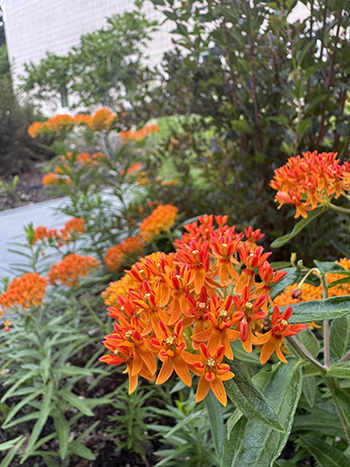
Asclepias tuberosa – butterfly weed
One might be more familiar with these bright orange clusters of flowers (and their usual winged clientele). Asclepias tuberosa, more commonly known as butterfly weed, frequents many a home garden, adding texture, color, and a hardy native nectar source for pollinators.
Native to the lower 48 states and parts of Canada, this bushy perennial boasts flat-topped pops of showy bright orange flowers that are sure to add vibrant color to any garden it’s planted in. Once established, expect this plant to grow up to 1.5-2 ft. tall, with stiff, dark green stems and alternate, pointed leaves.
This plant will help entice native pollinator species to one’s garden, boosting plant fertilization and improving native species biodiversity. Not only utilized by butterflies and bees, this Asclepias species is used by goldfinches and other songbirds as well, who will use the plant’s seed pod fibers as a food source and as nesting material.
Asclepias tuberosa can be found across Scott Arboretum & Gardens, including in the Entrance Garden, the Pollinator Garden, outside of Singer Hall and Whittier Hall (around the meadows), and the Harry Wood Garden.
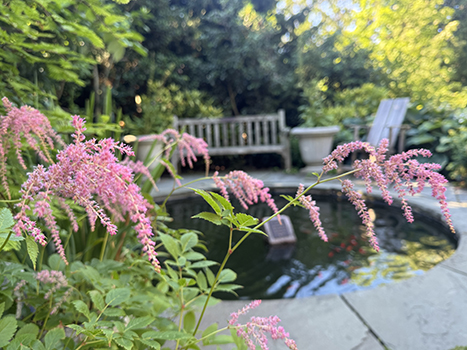
Astilbe ‘Straussenfeder’ (or ‘Ostrich Plume’) – astilbe
Lastly, but certainly not least, is Astilbe ‘Straussenfeder’, also commonly referred to as false spirea. First cultivated in 1952, and notable for its tall plumes of light pink flower panicles, this herbaceous perennial is also referred to interchangeably as Astilbe ‘Ostrich Plume’. (It’s worth noting that the German word ‘Straussenfeder’ translates to ostrich feather in English!) The Astilbe genus, however, is native to eastern Asia and eastern North America, with the ‘Straussenfeder’ cultivar being of Japanese origin.
Great for any gardener looking to add a bit of light spring-ish color or depth to their garden, this Astilbe variety grows in fern-like clumps (up to 20 in. in height) and produces erect and arching stems that can reach up to 2.5-3 ft. tall. Blooms are light pink, loose-packed, and often trailing or otherwise flowy, and many gardeners favor this plant by a water feature for this reason. Within the Scott Arboretum & Gardens, Astilbe ‘Straussenfeder’ can be found in the Terry Shane Teaching Garden in a sole planter next to the fish pool.
Blooms occur in late spring and into early summer and leave dried seed heads on the ends of the stalks. These seed heads are often favored decoratively by gardeners and left throughout the summer to add ornamental interest to one’s garden. The blooms are also attractive to pollinators, and one might consider this variety for pollinator gardens!