
Plants of the Week by Kaiden Lytle, Summer Education Intern
If you’ve ever wished you could add plants to your garden that make it look like alien life has taken hold, then stay tuned for this week’s ‘Plants of the Week’ selections!
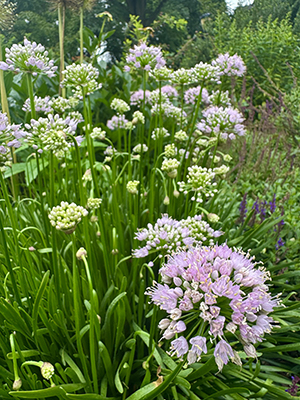
Allium ‘Millenium’ – ornamental onion
First off is a spiky, globular, blooming perennial that will make passersby stop and marvel at its unique shape. I am talking about Allium ‘Millenium’, otherwise known as ornamental onion. This plant is often used in garden borders as the purple color and planetary shape is eye-catching. Each bloom is large and packed with little star-shaped florets, and in a drift or group can look akin to floral fireworks.
Easy to establish in your garden and drought tolerant, this plant grows best in well-drained soil and full sun, where it will naturalize readily and return year after year as a hardy bulbous perennial. Gardeners also favor Allium ‘Millenium’ as a temporal gap-filler: it will bloom to fill the season between spring bulbs and early summer perennials. Within the Scott Arboretum & Gardens, you can currently find this plant in the Dean Bond Rose Garden, Cut-Flower Display Garden, gravel culture beds, John W. Nason Garden, and around the entrance of the McCabe Library.
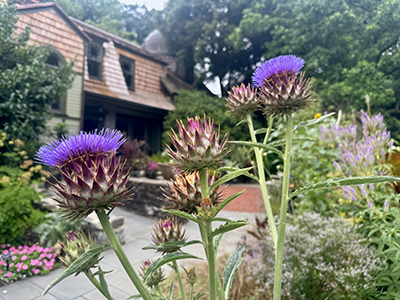
Cynara cardunculus ‘Florist Cardy’ – cardoon
For those gardeners that prefer varied textures in their garden, you might be excited by the next featured plant this week: Cynara cardunculus ‘Florist Cardy’, commonly known as cardoon or artichoke thistle. Closely related to globe artichokes, and similarly edible, this is an extremely fun plant all around. Unlike the artichoke, however, it is not the fruit or flowers that are edible but rather the blanched leaf stalks! When established in your garden, Cynara cardunculus ‘Florist Cardy’ presents as thick stalks with silvery foliage, and in the summer season, this plant boasts dramatic spiky blooms in varying shades of violet.
This perennial is native to the Mediterranean region, and thrives in warm, sunny, dry conditions, but can still grow in colder regions as an annual or less-hardy perennial. Within the Scott Arboretum & Gardens, you can currently find Cynara cardunculus ‘Florist Cardy’ within the Entrance Garden, outside of the Cunningham Building.
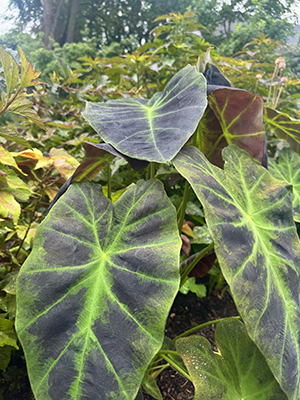
Colocasia esculenta ‘Illustris’ – elephant ear
Unlike the other two showcased flowering plants, this last featured plant is not planted for its blooms, but rather the striking foliage. I am talking about Colocasia esculenta ‘Illustris’, of course, commonly known as elephant ear or taro. While it can bloom briefly in summer, producing small yellow flowers, the blooms are infrequent and sparse, even in the best of conditions. The real show-stopper, the leaves, are huge and heart shaped (up to 3 ft. long), drooping artfully from the long petioles. The leaves are dark purple to almost black, with electric green coursing through each vein. This plant is a head-turner!
As a tropical perennial, it will thrive in sunny to part-shade areas with rich, moist soils. Be careful of planting too far away from other plants, as the leaves are sensitive to wind gusts, and can break easily without nearby shelter. Regarding height and cohesiveness in your garden, the above-mentioned plants are quite tall, and add a lot of vertical texture and color to the top layers of your garden. If you feel you need a nice medium-height addition, Colocasia esculenta ‘Illustris’ will help to add some balance within the mid layers of your garden. Within the Scott Arboretum & Gardens, you can currently find this plant interspersed within the Terry Shane Teaching Garden.