
Plants of the Week by Natalie Ipock, Summer Horticulture Intern
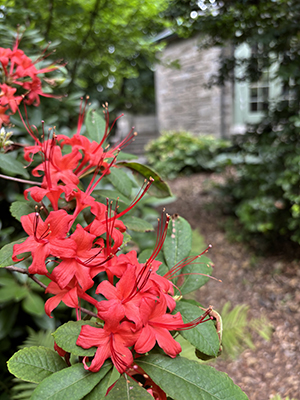
Rhododendron prunifolium ‘Hohman’ – plumleaf azalea
Blooming bright red on the edge of our Rhododendron Collection, you’ll find Rhododendron prunifolium ‘Hohman’. The cultivar ‘Hohman’ highlights the beautiful red blooms with a hint of orange. Growers commonly use Rhododendron prunifolium to develop late-blooming azalea cultivars. Usually, the bloom time for rhododendrons ends by June, but this species helps extend the blooming season to September.
Rhododendron prunifolium is only found in the Chattahoochee River Valley between Georgia and Alabama. Because of its scarcity, it is one of the rarest azaleas in the eastern United States. In 1918 Arnold Arboretum – located in Boston, MA – became the first to grow this azalea outside of its native range.
When choosing a planting location, make sure the soil is acidic and well drained. It is a deciduous shrub that prefers partial to full shade. This species is great for attracting pollinators during the summer and can grow about 8-12 feet tall. You can find this azalea off the pathway to the Amphitheater in front of the Scott Map House.
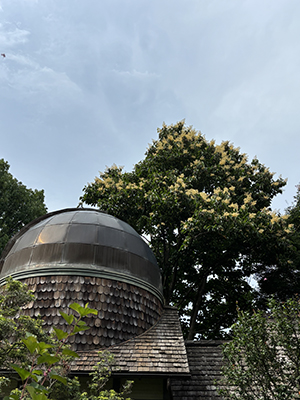
Poliothyrsis sinensis – pearl-bloom tree
In 1993 J. C. Raulston gifted six pearl-bloom tree seedlings to the Scott Arboretum & Gardens. While only two remain, they’ve grown into magnificent, blooming trees and are a must-see on a mid-summer visit to the Arboretum. The gorgeous, pale yellow flowers perfectly outline the old observatory on the Cunningham House.
The pearl-bloom tree gets its common name due to the flower buds, which do not fully open, appearing pearl-like. Poliothyrsis sinensis is native to central and eastern China on deciduous mountainsides and is the only plant in its genus. It can grow up to 40 feet high with a 25-foot spread.
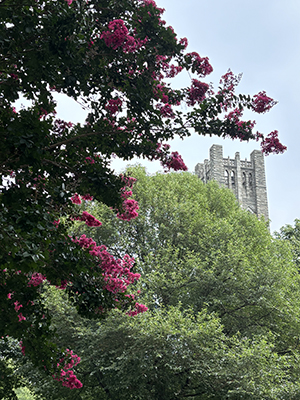
Lagerstroemia indica ‘Whit III’ – Pink Velour® common crapemyrtle
Lagerstroemia indica ‘Whit III’ is a deciduous tree that thrives in a full sun environment. It blooms a magenta pink color from July through September and has textured exfoliating bark year-round. This common crapemyrtle’s spread and height can reach up to 12 feet, but in the deep southern US, it may exceed 12 feet and need to be cut back. In the fall, this cultivar’s leaves turn orange-brown in color.
Although many Lagerstroemia suffer from powdery mildew, the Pink Velour® common crapemyrtle is resistant to such diseases. Dr. Carl E. Whitcomb was the original breeder for this plant and patented it in 2020. You can find these Lagerstroemia indica ‘Whit III’ along the western wall of Parrish Hall.