
Plants of the Week by Kaiden Lytle, Summer Education Intern
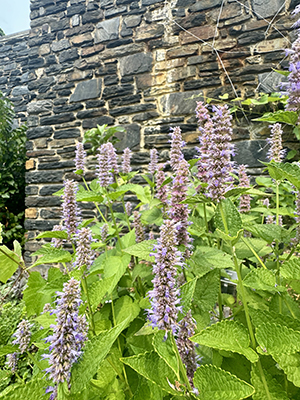
Agastache foeniculum – anise hyssop
This week’s first highlighted plant is prominently featured in my favorite children’s book in the Scott Horticultural Library: Mirabelle Visits a Garden by Gregg Tepper and Michael Muller. In addition, it also belongs to a plant family with square stems and ostentatious scents. Does that narrow it down? No? I am talking about Agastache foeniculum, of course, commonly known as anise hyssop, from the Lamiaceae family. This herbaceous perennial has got a lot going on, with its fragrant foliage, edible seeds, striking form, and flowering patterns.
Anise hyssop has an erect growing habit and tall stems that terminate in spikes of small flowers, arranged in crowded whorls. The blooms have a licorice-like scent, and are commonly included as flavoring in food and drink (Mirabelle Visits a Garden has a scratch and sniff sticker that illustrates this). The seeds have a similar flavor, and people often use them in baked confections. You can harvest these attributes beyond the summer, as the flowering period stretches from the end of July into late autumn! This plant does best in USDA Hardiness Zones 4a to 8b, and the flowering season will shrink as you extend to the lower limits of this range. Its native range spreads throughout the Midwest, and anise hyssop is a common prairie dweller. Albeit there are no prairies within the Scott Arboretum & Gardens, Agastache foeniculum resides in the gravel culture beds along Field House Lane, as well as tucked away in the corner of the Dining and Community Commons’ West Garden.
Cercis canadensis ‘Ruby Falls’ – eastern redbud
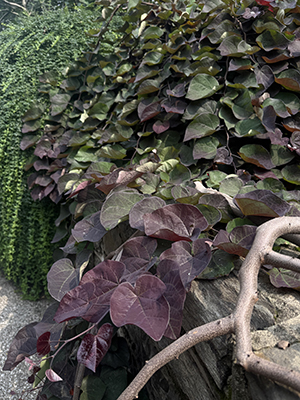
Next is an award-winning variety of a familiar native woody plant: Cercis canadensis ‘Ruby Falls’. The eastern redbud is a deciduous tree in the legume family Fabaceae and is widespread across eastern and central North America. Its large, ovate, heart-shaped leaves are a distinctive identifier, as are its legume-esque seed pods. This cultivar sports a captivating form and foliage, bred in 2010 from a cross of Cercis canadensis ‘Covey’, a weeping variety, and ‘Forest Pansy’, which has maroon-purple foliage. So captivating, in fact, that it secured the Royal Horticultural Society’s Award of Garden Merit!
Not only flaunting stunning foliage, ‘Ruby Falls’ also displays tiny, pink, pea-shaped flowers on bright red stems in the spring before leaves emerge. As spring matures into the summer months, this tree further delights as the foliage turns burgundy before settling into its late summer greens. All of this is why ‘Ruby Falls’ deserves a prominent spot in your garden. Many people favor ‘Ruby Falls’ as a specimen plant, which has the tendency to demand attention in a garden space. It’s flashy! Within the Scott Arboretum & Gardens, you can spot ‘Ruby Falls’ cascading down the stone wall on the western side of Pearson Hall, as well as in the Isabelle Cosby Courtyard (one last fun fact – the tree that is trailing down that stone wall is actually three individuals, shaped into a redbud waterfall!).
Metasequoia glyptostroboides – dawn redwood
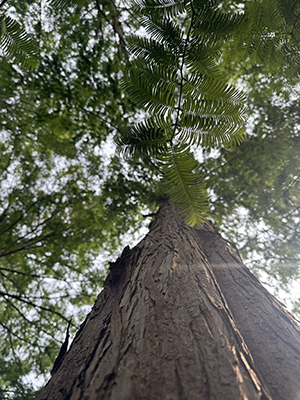
Last in the lineup this week is the king of Cupressaceae: Metasequoia glyptostroboides, or the dawn redwood. It’s fitting that this plant is last as it is the oldest featured species this week, clocking in at around 50 million years old. Native to central and western China, it was first described from fossil records in 1941 – NOT from a living specimen – which is unbelievably cool. It wasn’t until the late 1940s that researchers discovered living examples of dawn redwoods during a remote expedition in China. Notably, the common name “dawn” refers to the “dawn of time,” as a nod to the tree’s ancient origins!
Not only king in genealogical history, this deciduous conifer is also royally gargantuan, towering to 100 feet tall and 25 feet wide at maturity! Breathtaking when fully grown, the dawn redwood’s feathery foliage helps to filter sunlight to lower layers, as well as adding another layer of beauty to this species. In the fall, the foliage will turn from light green to copper before shedding.
Now, I would not recommend planting this tree in your garden unless you are truly a diehard fan. These trees require a plethora of open space, deep soils, and an idyllic spot to dominate the garden’s focus. At the Scott Arboretum & Gardens, the most prominent display of this “living fossil” lines the aptly named Metasequoia Alleé, between the Lang Performing Arts Center and Kohlberg Hall.