
Plants of the Week by Natalie Ipock, Summer Horticulture Intern
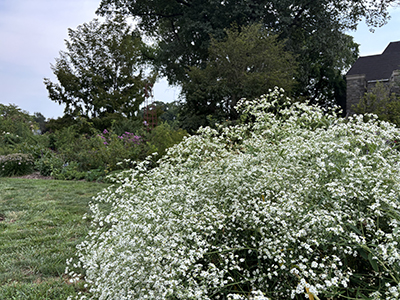
Euphorbia corollata — flowering spurge
Next time you walk through the Dean Bond Rose Garden, take notice of all the perennials intentionally planted throughout the beds. While older rose gardens tend to consist of a monoculture of roses, modern rose gardens plant perennials throughout the roses. The issue with solely planting roses is that disease spreads fast, and pesticides must be sprayed every couple weeks. In 2012, Scott Arboretum transitioned from a monoculture of roses to perennials inter-planted because they attract beneficial insects and establish physical barriers between each rose plant.
Euphorbia corollata is one of the perennials that are currently blooming in the Rose Garden. When I first saw this plant in the Rose Garden I thought it was Gypsophila paniculata, also known as baby’s breath. However, since baby’s breath is an invasive plant in the United States, flowering spurge is a common native alternative. Blooming from June through August, this plant loves full sun and attracts many pollinators. Flowering spurge can also tolerate many soil types, making it adaptable to different environments. Next time you pass through the Dean Bond Rose Garden, appreciate the beauty of the perennials inter-planted amongst the roses.
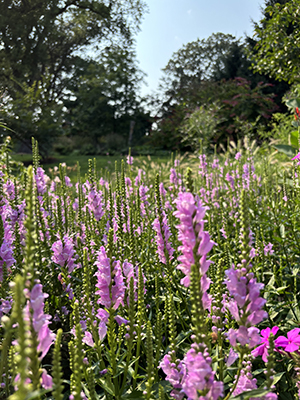
Physostegia virginiana ‘Vivid’ — obedient plant
Located in the Cut-Flower Display Garden is a striking plant named obedient plant, featuring beautiful pink blooms along its stalk. When you first think of an obedient plant, you may think of one that doesn’t spread too much. However, that is not the case for Physostegia virginiana ‘Vivid’ since it spreads in clumps and by rhizomes. In actuality, the common name comes from the flowers’ ability to stay in place after gently pushing them to the side. Instead of springing back like most plants, they return back to normal over the course of a few hours. Besides the unique properties of the flowers, make sure to take notice of the square stem since it is in the Lamiaceae family.
The obedient plant blooms mid-summer to the first frost and is also resistant to deer. They’re perfect for many home gardens because they love full sun to partial sun and are quick growing. Taller plants may flop over, so staking should also be expected for this plant. Pollinators such as bees, butterflies, and hummingbirds love visiting Physostegia virginiana ‘Vivid’, so keep an eye out for these vibrant visitors.
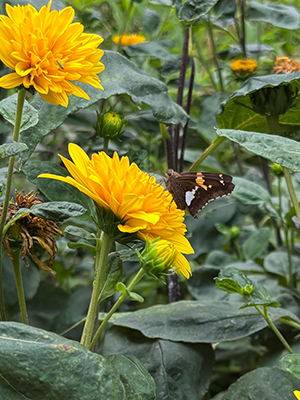
Helianthus × multiflorus ‘Sunshine Daydream’ — double perennial sunflower
While this plant may look like a dahlia, it is actually Helianthus × multiflorus ‘Sunshine Daydream’ — a type of sunflower. It originated as a genetic mutation from Helianthus ‘Capenoch Star’ and was discovered by Tim McGinty in 2006 at North Creek Nurseries.
What makes this particular perennial sunflower stand out from the others is its longer flowering season from summer into fall. Not to mention, it forms in clumps and is drought tolerant. At your next visit to Scott Arboretum, make sure to check out this gorgeous sunflower in the Upper Biostream.