
Plants of the Week by Kaiden Lytle, Summer Education Intern
Rudbeckia ‘American Gold Rush’ – black-eyed Susan
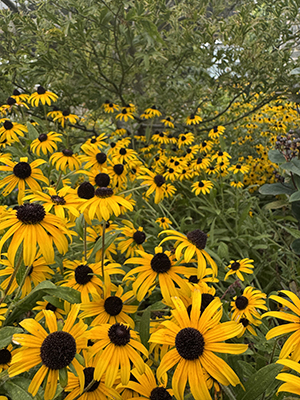
If you have visited the Scott Arboretum & Gardens recently, you may have seen the giant drift of bright yellow flowers in the Harry Wood Garden. You might even have been lucky enough to see some matching, bright yellow birds flying in and out of them! These, of course, are the Rudbeckia ‘American Gold Rush’, or black-eyed Susan, and their faithful counterpart the American goldfinch. This plant is a herbaceous perennial in the Asteraceae family, and the parent species is a common member of many a sunny home garden.
Black-eyed Susans are as hardy as they are pretty, and will tolerate both hot and humid summers, and hot and dry summers (though only drought tolerant once established). Their distinctive blooms feature daisy-like yellow flowers that usually feature a dark brown or black ‘eye’ of florets. This disk of florets in the middle of the bloom is what the American goldfinches love. This species, like many goldfish snacks, have prominent seed heads or capsules that the species loves to pry and nibble. Often found in drifts or masses, these plants typically form clumps as they grow. Rudbeckia is popular for large container plantings, perennial borders, mixed native plantings, and cutting gardens.
The selected cultivar ‘American Gold Rush’ differs not in coloration, but rather the form and function, appearing compact with small foliage (~2 inches) and bred with a specific resistance to septoria leaf spot: a fungal disease that causes small dark spots on the leaves of the plant, starting on the bottom leaves and working its way up, and most transmissible in very moist/humid environments. The cultivar is notably smaller than its seed parent, Rudbeckia fulgida var. deamii, reaching about 1.5 – 2 feet in height.
Within the Scott Arboretum & Gardens, you can find ‘American Gold Rush’ in the Harry Wood Garden and the John W. Nason Texture Garden.
Stewartia sinensis – Chinese stewartia
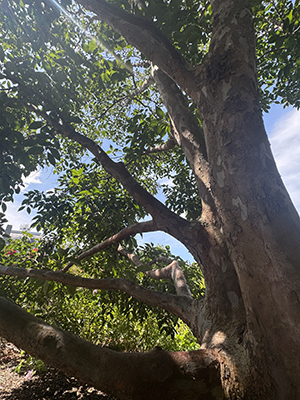
Just on the edge of the Dean Bond Rose Garden lies a small flowering tree with beautiful mottled brown bark. Easy to miss, especially out of season, this hidden feature is called Stewartia sinensis, or Chinese stewartia. This member of the Theaceae family can be found as a small tree or large multi-stemmed shrub, and is native to central and southeast China. Notably, the latin species name sinensis means “from China.”
In the gardening world, Stewartia sinensis is usually selected for its ornamental value, as the bark is particularly eye-catching. Paper-like strips peel in a variety of reds and browns, leaving a lighter brown to sand-colored trunk underneath. The tree form typically adheres to a strict, oval shape, but young saplings can open up in the upper canopy as they mature. In early to mid summer, you can expect white blooms of small, fragrant, bowl-shaped flowers, usually accompanied by a small army of buzzing bees. This stewartia is also an autumn favorite. The tree will keep some color in your garden as the foliage turns reddish-purple and is adorned with woody capsules late into the season.
Given its mature size, branching habits, and woody nature, this plant is usually favored for an accent in a home or pollinator garden, or a stand-alone in your yard. If you need inspiration, this specimen helps lock in the outer border of the Rose Garden, where it drapes gently over the northeastern edge of the garden.
Euscaphis japonica – Korean sweetheart tree
Last this week, but certainly not least, is Euscaphis japonica, commonly known as the Korean sweetheart tree (and recently going as Staphylea japonica). This hardy perennial shrub is currently in its own genus Euscaphis, within the bladdernut family, and is pretty rare to have in cultivation. The genus is currently up for debate as taxonomists consider reclassifying it as a member of the specific bladdernut genus Staphylea, rather than keep it separate on its own. In the Arboretum, this plant is still listed under its solo genus.
First discovered in the horticulture world in 1985 on the Korean Peninsula, Euscaphis japonica was collected as seeds and sent to the North Carolina State Arboretum for assessment. Because of that preliminary assessment, and subsequent research, I can tell you with certainty what this plant likes and dislikes. It does best in full sun and well drained soils, and it prefers cooler summers to the hot and dry. When considering it for your garden, note that transplants have more success than attempting growing from seed.
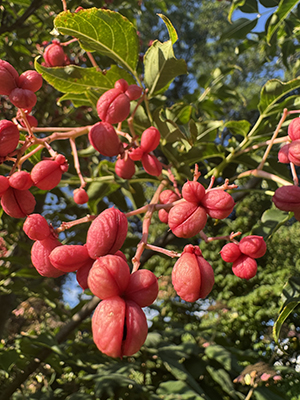
In terms of appearance, the Korean sweetheart tree has irregular, open-form branching, with striking white-striped brown bark. Foliage is unremarkable, except in fall when the leaves turn mahogany. Flowers are small and white to yellow, and appear in early summer. The big draw of this plant, besides the bark, are its heart-shaped seed capsules – hence the “sweetheart” title! They turn an intense hot pink to red color in the fall and pop open to reveal shiny black seeds within.
Within the Scott Arboretum & Gardens, you can find Euscaphis japonica in the Terry Shane Teaching Garden and on the eastern side of Beardsley Hall.