
Plants of the Week by Caelon Shugrue, Public Horticulture Intern
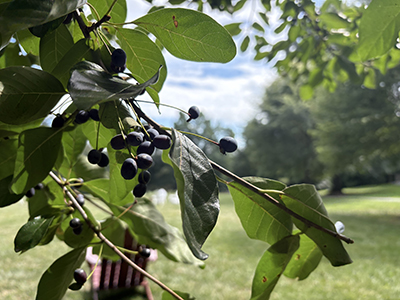
Nyssa sylvatica – black tupelo
Before its foliage lights up bright red in the fall, Nyssa sylvatica (also called black tupelo or blackgum), produces something sweeter and tastier. The black tupelo fruits are classified as “drupes,” which are fleshy fruits containing one pit or stone that holds a seed. These small, unassuming drupes are edible and boast a flavorful, sour punch! But be quick with your foraging; birds and other wildlife enjoy the fruits as well.
Plants typically have male flowers, female flowers, or perfect flowers containing both male and female reproductive parts on a single flower. A monoecious plant has female and male flower parts on the same plant, whereas a dioecious plant has separate functionally female and male flower parts on different plants. For example, corn (Zea mays) plants have male and female flowers on the same plant, making it monoecious. Maidenhair trees (Ginkgo biloba), on the other hand, have separate male and female trees. Black tupelo, however, doesn’t fall into either category. Instead, every Nyssa sylvatica tree has perfect flowers, but they also carry either female or male flowers on the trees as well. Thus, the flowers of black tupelo are a wonderful display of the diversity found in nature. Botanists describe trees like N. sylvatica as “polygamo-dioecious.”
Often unassuming in the spring and summer, black tupelo has simple leaves and a simple form. Native to the United States, Canada, and Mexico, this tree is found in swampy woods and well-draining uplands, where it tolerates standing water and acidic soils.
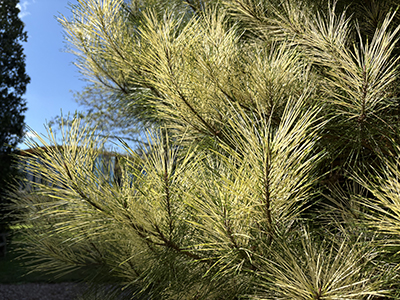
Pinus densiflora ‘Burke’s Red Variegated’ – Japanese red pine
This variegated pine has striking, creamy bands on each needle that persist year round. From far away, this variegation makes the plant appear as though it is glowing. Nestled in the pinetum, this Pinus densiflora ‘Burke’s Red Variegated’ is a type of Dragon’s Eye pine. These types of pines, when viewed from the tip of the shoot, resemble an eye due to the needle variegation.
The straight species Pinus densiflora is native to Eastern Asia, where it grows best in full sun and well-draining soil. The same is true for this cultivar. In the wild, these trees can get to over 100 feet tall, but the cultivated varieties typically reach 15-20 feet tall. This tree would be a perfect addition to any garden; it is tough and vigorous, and it displays a wonderful combination of color and texture.
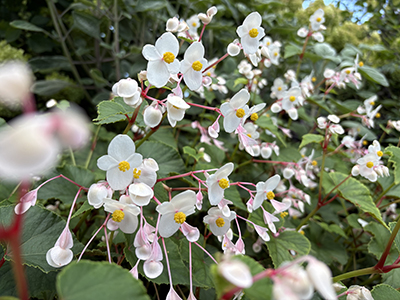
Begonia grandis subsp. evansiana ‘Alba’ – white-flowered hardy begonia
This hardy begonia, native to southern China and Japan, is found throughout the entrance garden around the Cunningham House. Its leaves may seem humble from the top, but the underside boasts a stunning array of vibrant red veins. The foliage of this plant forms a lush mound, and in the late summer and early fall, pale white flowers emerge above the leaves. These flowers may be simple, but the sheer volume of flowers peppered throughout the plant make this species quite striking.
At the tips of Begonia grandis branches, there hides a secret to their success. Miniature bulbs, known as bulbils, form on the ends of these branches. These asexual reproductive bulbils are highly-engineered packages of DNA, designed to survive harsh winters and freezing temperatures. However, they cannot be buried with soil or they won’t sprout. Begonia grandis is the only Begonia species that produces bulbils. Along with its underground tubers, these bulbils aid the plant in forming small clumps and colonies and occasionally taking over the garden.