
Plants of the Week by Caelon Shugrue, Public Horticulture Intern
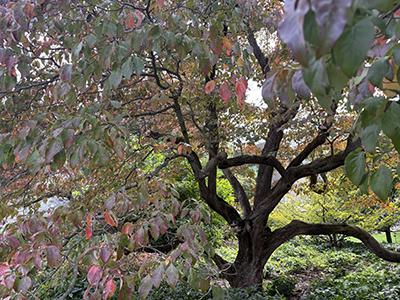
Cornus florida forma rubra – pink-flowering dogwood
It is fall in Pennsylvania, which means our deciduous trees and shrubs are beginning to change colors to display their wonderful autumn splendor. Chlorophyll pigments make plant leaves green by reflecting green light during photosynthesis. However, as fall approaches, days get shorter and colder, causing trees to reduce photosynthetic rates and prepare for winter dormancy. The chlorophyll breaks down, and other pigments previously masked by chlorophyll get their brief moment to shine.
Plants, like this pink-flowering dogwood, express red leaves due to an additional pigment called anthocyanin. This pigment protects the photosynthesizing chloroplasts by absorbing high-energy light photons that would otherwise damage the cells. Leaves in direct sunlight often produce more anthocyanin compared to shaded leaves, making sunny leaves more red in color.
This dogwood, found on the Science Center lawn, has begun senescing, and the leaves display a beautiful array of green, red, and purple. In addition to the beautiful leaves, the form of this dogwood is captivating – its graceful branches stretching into an expansive canopy. Now, if you look closely enough, you can see the quaint, little flower buds for next year at the tips of many branches.
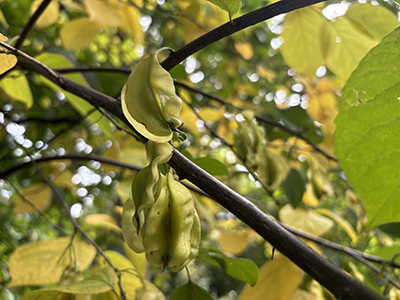
Halesia diptera Magniflora Group – two-winged silverbell
This silverbell has beautiful, yellow leaves during autumn due to the carotenoids remaining in the leaf. Among carotenoids, some pigments photosynthesize (xanthophylls) and others do not (carotenes). Although carotenes do not photosynthesize, they protect the leaf cells from damaging excess light. These pigments, that have been working behind the scenes with chlorophyll, now get their spot in the limelight.
In addition to the two-winged silverbell’s yellow leaves, its fall interest comes with winged fruits. The other species in this genus, Halesia carolina (Carolina silverbell) has a fruit with four wings. These fruits start light yellow and turn a darker tan color over the course of the fall season. The long draping branches characteristic of silverbell trees allow passersby to easily spot these fruits. This silverbell is found in the West Circle beside Parrish Hall, where it thrives in dappled shade as an understory tree.
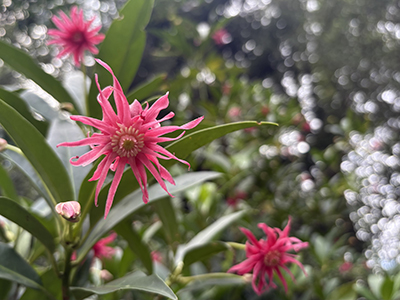
Illicium ‘Woodland Ruby’ – hybrid anise-tree
This evergreen shrub is not like the two previously mentioned plants; its leaves stay green year round. While the color may not speak to a northeastern autumn, Illicium ‘Woodland Ruby’ leaves have their own hidden talent. When crushed, they emit an aromatic smell of anise or licorice. Although safe in a tangible, crushed capacity, avoid ingesting the poisonous leaves. Only one species in the Ilicium genus (Illicium verum, known as Chinese star anise) has edible berries used in teas, spices, and essential oils.
While its leaves are green and aromatic, its beautiful flowers are the real showstopper. This Ilicium is a cross between I. mexicana (native to Veracruz, Mexico) and I. floridanum (native to Florida), first introduced by Woodlanders nursery in South Carolina. This cross gives ‘Woodland Ruby’ the ability to bloom for longer and tolerate more sun compared to the straight species. This plant is found in the evergreen screening between the Sibbet Garden and the Amphitheater, where it enjoys shade and moist soils. Look for this plant as it continues to bloom throughout the fall with its stunning, deep red flowers.