
Plants of the Week by Caelon Shugrue, Public Horticulture Intern
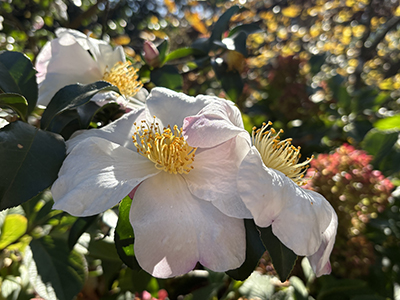
Camellia Ackerman 90-1 – camellia
Displaying large, white, aromatic flowers, this camellia sure is welcoming fall. With the recent ending of daylight savings, these large flowers and their rosy aroma may bring some much needed joy in these increasingly shorter days. These Ackerman hybrid group camellias can survive late-autumn temperatures as low as -10°F. They didn’t evolve in this region, however. The camellia travelled thousands of miles, over oceans and continents, with a rich tale of international trade and generations of cultivation to land at the Scott Arboretum & Gardens.
China has a long and expansive history with Camellia cultivation and hybridization, dating back to the Tang Dynasty (618–907 AD). Since the Tang Dynasty, generations of people propagated Camellia sinensis for tea, and it was thus a major product for trade within Chinese provinces. Global trade with the British East India Company in the 1600s brought tea from China to Europe. Infatuated with tea, the Europeans wanted to cultivate the plant for themselves. In the 1700s Europeans tried to import camellia plants for the purpose of tea production but instead of sending Camellia sinensis, China sent Camellia japonica instead. This blunder led to the ornamental appreciation of C. japonica – the first living record of this plant is in the greenhouse of the wealthy Lord Petre of Thondon Hall, Essex, England. Eventually receiving some C. sinensis for tea cultivation, the British came to the hard realization that the camellia does not thrive in the dreary English climate.
The United States also has a rocky history with the success of growing camellias. Introductions in 1744 and again in 1772 failed to successfully grow these Camellia sinensis. Finally in 1786, Andre Michaud (botanist for King Louis XVI of France) brought Camellia japonica ‘Reine des Fluers’ to the Middleton Place in Charleston, South Carolina. Successful cultivation of these camellias led to the eventual distribution of camellias throughout the south.
The story of the cold-hardy Camellia Ackerman 90-1 is similarly fraught with trial and error. In 1948 unidentified camellia seeds from China, designated only as plant introduction (PI) number 162475, were shipped to the U.S. National Arboretum in Washington D.C. Once these tiny, unassuming seeds were planted and grew into small trees, they revealed ordinary white flowers. Not nearly as interesting as their peer Camellia sasanquas, PI 162475 were promptly forgotten. 30 years later after a severe winter storm destroyed those C. sasanquas, the humble, forgotten PI 162475 (later discovered to be Camellia oleifera) survived.
Horticulture expert William Ackerman, on a mission to breed cold-hardy camellias, hybridized cold-hearty C. oleifera with many other camellias including its flashier cousin C. sasanquas. Ackerman achieved a series of ornamentally interesting and cold-hardy camellias that are now staples in North American gardens.
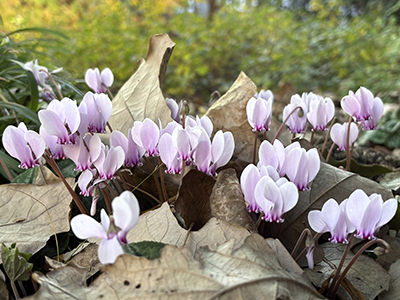
Cyclamen hederifolium – Persian violet
Emerging just a few inches above its foliage, this Persian violet brings a pop of color to the otherwise brown, leaf-littered forest floor. Flowers are produced in the late summer to autumn before the leaves. These flowers are self-fertile, meaning that the pollen of one flower is able to pollinate an egg of that same plant. Plants that are not self-fertile, like apples, need pollen from a genetically different plant to fertilize their egg. These crosses often result in more genetic diversity compared to self-fertile plants.
While populations of self-fertile plants may have less genetic diversity, Cyclamen hederifolium displays a vast array of morphological characteristics and gene expression. There are many populations of Cyclamen hederifolium across campus, and different populations have flowers of various colors and patterns. You can find pink ones behind Parrish Hall and in the Cosby Courtyard and white violets in the Harry Wood Garden!
Native to woodlands and rocky areas at high altitudes in the Mediterranean, this plant actually goes dormant in the first few weeks of summer. Persian violet pushes out flowers and foliage in fall, with leaves continuing to grow in winter. Seed pods then mature in winter and spring, opening before the plant goes dormant in the summer. Once dropped (or planted in your garden) seeds can sometimes go dormant for up to three years! In native areas prone to drought, this dormancy staggers germination and protects the species population from being wiped out in dry years.
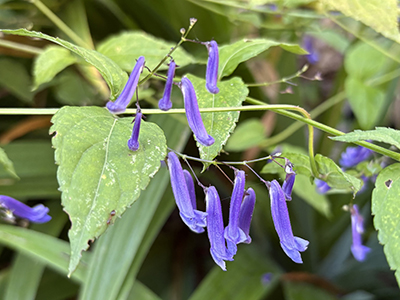
Isodon longitubus (syn. Rabdosia longituba) – long-tubed spurflower
The final plant of the week is another late-blooming plant. As the oaks, maples, and chestnuts of campus garner affection, don’t forget about the deciduous perennials! With electric blue flowers and foliage that takes on a purple hue in autumn, this plant would be a great addition to any garden in need of late fall interest. Native to mountains in Southeast China and Japan, Isodon longitubus has long, dainty, tubular flowers cascading down the stem. This plant flowers best in partial shade, and its spot on the edge of the Nason Garden ensures abundant blooming.
In addition to Isodon longitubus, this plant is known by many names including: Plectranthus longitubus, Rabdosia longituba, and Amethystanthus longitubus. All four genera (Isodon, Plectranthus, Rabdosia, and Amethystanthus) exist in the mint family or the Lamiaceae family. As taxonomists reevaluate which tribes and subtribes exist within families, sometimes plants like I. longitubus get caught in the middle. Nurseries and plant growers may list all previous names, but the scientific community has landed on Isodon longitubus for now.