
Plants of the Week by Caelon Shugrue, Public Horticulture Intern
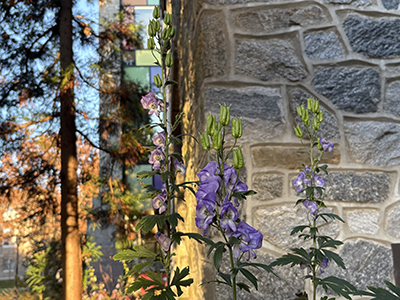
Aconitum sp. PMD – monkshood
The monkshood plant gets its name from the hood-like sepals that protect the reproductive parts of the flower. These purple flowers are perfectly shaped for pollinators like bees to collect pollen and nectar from the plant. A highly toxic plant, this monkshood is a perennial with tuberous roots and has a long history of being used for its poisonous properties. Native to North America, Europe, and Asia, people across the globe harnessed this genus of plants for warfare, hunting, and medicine.
In Northeast India, Acontium-derived poison was used to coat the tips of hardwood or bamboo spikes during tribal warfare. In this case, the poison was created by mashing the Acontium with another poisonous plant (Cronton tinglium) for increased toxicity and wild potato to create a paste. In Europe, this plant was used to kill wolves by lacing meat scraps with the tuberous roots. Across Asia and Europe, hunters would prepare arrows with poison extracted from this plant to kill large game like bears. Indigenous people living in Alaska historically used this poison when whaling as well. In Chinese medicine, the alkaloid aconitine was implemented as an anesthetic. Cultivation of this plant and remedy was highly regulated and tightly controlled.
The genus name Acontium originates from the Greek word “Akonitos,” which means “without struggle.” We can dissect the etymology of this word even further. “Ak” means sharp or pointed, and “konos” means cone – referring to the plant’s pointed leaves. In Greek mythology, the story behind Aconitum’s poisonous effects goes back to the legend of Heracles. In the myth, Heracles (known in Roman mythology as Hercules) fought Cerberus, the three-headed dog guarding the entrance to the Underworld, on the Hill of Aconitus. Cerberus’ saliva dripped onto the plant, rendering Acontium poisonous forever. Other legends say that the plant itself came from Cerberus’ mouth. But don’t worry, you don’t have to fight a three-headed dog to find this plant, just venture to the garden beds behind Kohlberg Hall!
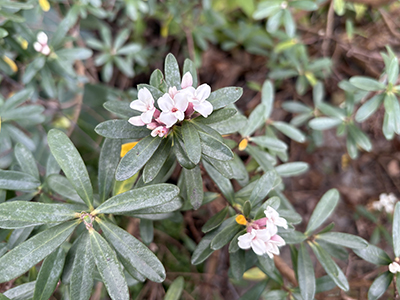
Daphne × transatlantica ‘Blafra’ – eternal fragrance daphne
Currently flowering in the Harry Wood Garden, this hybrid daphne displays clusters of white and pink aromatic flowers. This daphne is a cross between a deciduous female D. caucasica and an evergreen male D. collina. Daphne is prone to significant winter injury with severe weather. If damaged by winter weather, they can become more susceptible to disease, rot, and insect pests. They can be slow to establish and temperamental, needing great drainage and protection from cold winter winds.
The genus name Daphne comes from another story in Greek mythology. Daphne, a water nymph, ran from the god Apollo and transformed into a laurel tree. In Greek, the word “daphne” even translates to laurel. Inspired by the myth, Swedish botanist Carl Linnaeus (often regarded as the father of modern taxonomy) named the genus Daphne because this plant’s evergreen leaves look similar to the laurels Daphne became. While birds enjoy the small red berries, they are highly toxic to humans, deer, and rabbits. All parts of the plant are toxic, when rubbed on your skin or ingested. None of this should stop you from trying out a daphne in a rock garden or as a small hedge!
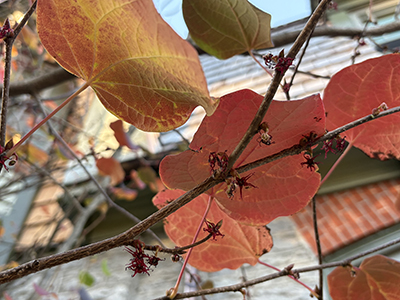
Disanthus cercidifolius – disanthus
Native to wooded areas of Southeast China and Japan, this disanthus displays small, charming flowers. Just about half-an-inch tall and wide, purple star-shaped flowers bloom not far off the branch. The genus name Disanthus is derived from Greek: “dis” meaning “twice” and “anthos” meaning “flower.” This refers to the fact that these flowers come in pairs – placed back-to-back.
Unlike the previous two plants, this disanthus is nontoxic! In addition to interesting flowers, the heart-shaped leaves of the disanthus turn a beautiful red color in the fall. Just as the Daphne genus name references its similarity to laurels, the species name cerdifolius in this case refers to its leaves’ likeness to the Cercis genus. Another common name for this plant is “redbud hazel” due to such similarities. It is remarkable that this shrub has a wonderful fall color at the same time as its impressive flowers are blooming. This plant is a member of the witchhazel family, these plants largely flower in fall and winter. You can find this plant behind the Cunningham House along the bluestone path where the flowers should be about eye level!