
Plants of the Week by Caelon Shugrue, Public Horticulture Intern
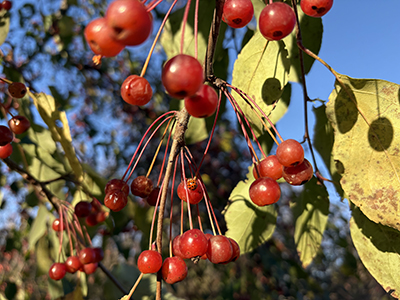
Malus baccata var. Jackii – Jack Siberian crabapple
With deep green foliage contrasted by bright red drupes, this crabapple stands out in the landscape. There are several North American crabapples, but this species is native to the forests in Siberia, Southern China, Japan, and the Himalayas. Found with other crabapples by the Whittier parking lot, the glossy fruit satisfies avian tastebuds during our late autumn months. Although the fruit is tart now, colder temperatures cause the fruit to sweeten up, better suiting human palates. Foragers can collect crabapples for a winter treat and turn them into juice or a puree for desserts.
Before the apple (Malus domestica) reached the prominence it has today, humans and birds naturally selected crabapples for a millennia prior to cultivation. Throughout Asia, the small fruits of M. baccata were collected by early people and distributed by birds. Archaeobotanical records of burial sites in the Kali Gandaki Valley in Nepal contain seed of M. baccata, illustrating the cultural significance of these fruit trees. The modern apple (M. domestica) is a hybrid of four separate apple species: M. sieversii, M. orientalis, M. sylvestris, and M. baccata. While the specific plant highlighted here is an ornamental variety, this specimen can still illustrate the importance of M. baccata in the cultivation of the apple today.
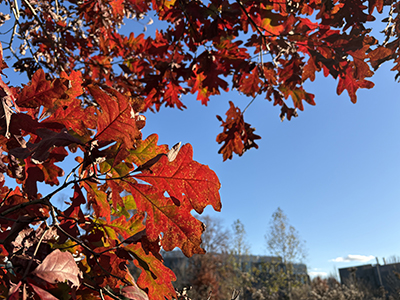
Quercus alba – white oak
Found all across eastern North America from Ontario to Florida to Missouri, white oaks are prized for their longevity, exceptional timber, and enormous canopy. At this time of year the lobed leaves display a wonderful crimson red. White oaks are outstanding trees that may live for over 200 years, with one specimen in Basking Ridge, New Jersey living over 600 years before it died. White oaks are also slow-growing trees, often taking 50 years to reach sexual maturity. However their expansive canopy and triumphant form is well worth the wait. This young white oak is found in the Whittier meadow, and maybe it too will live over 600 years.
The desirable attributes of white oak timber (strength, water-resistance, and rot-resistance) are due to the tyloses found in the tree’s cells. Tylosis is a growth on the cells that make up the sapwood. This growth extends into the xylem, the cells that transport water up the tree, thus blocking water movement. In addition to blocking water, these structures block the intrusion of fungi and other pathogens that may further break down wood. Due to these fortifications, white oak hardwood is essentially watertight and “rot-tight.”
In addition to their strength, wine and whisky distilleries prize white oaks for the flavor they add to drinks. White oak wood is lightly toasted for wine, which brings out a spiced and smokey flavor with notes of vanilla and cloves. For whisky making, the white oak is charred instead: this process is hotter and shorter than toasting. Charring is responsible for the whisky’s amber color and butterscotch flavors due to the caramelization of the sugars in the wood.
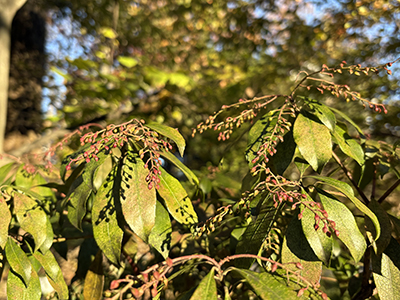
Pieris japonica ‘Katsura’ – Japanese pieris
With glossy green leaves providing a backdrop for these cascading flower buds, Pieris japonica ‘Katsura’ offers interesting color and texture even after the flowers have disappeared. The parent species, Pieris japonica, is native to the woodlands of Southeast China, Central and Southern Japan, and Taiwan. The cultivar ‘Katsura’ was cultivated in the rural Shimane Prefecture of Japan by Yoshimichi Hirose. In addition to this ‘Katsura’, Hirose has two other plant patents, both for variegated Japanese maples. What sets ‘Katsura’ apart is its broad, bushy habit, dark red foliage, and rose-colored panicles of flowers. The new growth on ‘Katsura’ continues through spring and summer with large, glossy, evergreen leaves emerging as wine-red before turning green.
Hirose sent cuttings from ‘Katsura’ to the nursery Plantentuin Esveld in the Netherlands for further multiplication. In the year of its introduction, 2003, ‘Katsura’ won a Gold Medal at the 2003 Planatarium international nursery trade fair in Boskoop, the Netherlands. Found in the Cherry Border, this plant is a unique addition to any garden with moist, well-draining, acidic soil in full sun or partial shade.