
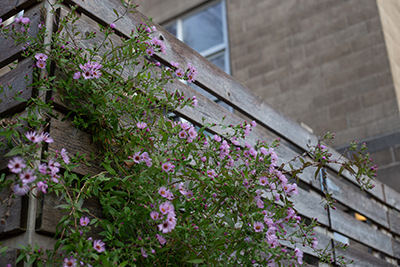
Ampelaster carolinianus – climbing aster
Plenty of plants climb and vine, but how many bloom in fall or late summertime? Garden Supervisor Chuck Hinkle first pointed out this lovely plant in August, promising all I had to do was wait. I circled back to this corner of campus, an unassuming fence behind Beardsley Hall that blocks unappealing equipment and dumpsters. At first, this Ampelaster carolinianus was just a climbing plant. Then, a few weeks later, I saw some early buds. Then, another few weeks later, they finally broke free in late October. With how busy it’s been around the Arboretum, I haven’t been able to give these flowers their flowers.
Asters provide simple sparks of joy. Each little head inflorescence may teem with tiny florets, but from a distance, they’re rather common. For months, different asters have been popping in and out of the wildflower landscape, and amidst that flurry, the purple-flowered, yellow-centered Ampelaster carolinianus might get lost in the mix. This is where the timing is key. Instead, they’re an autumnal surprise, facing otherwise falling leaves and senescence across campus, and finding a pocket of reigning blooms. This late bloomer turns a plebeian flower into a crown jewel.
All exaggerations aside, it’s a cheerful little blossom when the wind is nippy and the sky is gloomy. The flowers coat the skinny-leaved climber in purple delight. You can almost imagine the splendor in a few years when the plant has thoroughly ensconced the wooden slats.
Unfortunately, these sprightly sights have already bowed out. If you’re hoping to catch a whiff of these last-minute superstars, you’ll have to wait your turn for next season. Or grow your own! These crawling perennials could spice up a fence, a wall, a shed, a trellis, or any sturdy frame around your house, promising pops of purple while much else in the garden shifts to bronzes, yellows, and browns. Plant in a garden spot with plenty of good drainage and average water, ideally with more sun to encourage greater flowering. Deadhead the flowers in early winter, but avoid pruning until the new growth is visible in the spring.
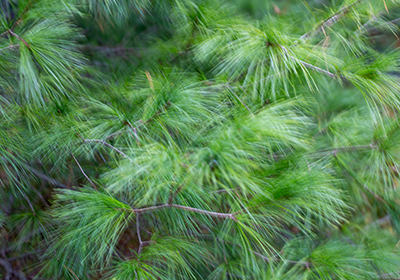
Pinus strobus – eastern white pine
Leaves may have fallen from the deciduous angiosperms, but this time of year, needled evergreens are a garden staple. And the cuddliest of them all has got to be Pinus strobus. Eastern white pine’s bundles of quintuplet needles rustle gently in the wind and bend easily to the touch. It’s a forgiving plant where Picea and Abies bristle and poke.
Back in the early days of North American colonization, eastern white pines were prized for their straight, tall trunks. The wood is easy to work with, and they’ve been frequently used for timber, ship masts, and construction lumber. The Pine Tree Riot of 1772 was actually a result of the King of England claiming the best and tallest of the eastern white pines, and revolutionaries flew the pine tree flag as a symbol opposing tyranny during the American Revolutionary War.
In the wild, these trees can teeter as high as 100 feet. Historical records indicate some eastern white pines were even 200 feet tall. However, many of these giants have fallen victim to white pine blister rust, a fungal infection first spread from Ribes spp. that initially infects the needles, then forms cankers on the branches. Infections that reach the trunk can girdle a tree, cutting off its water and nutrient transport mechanisms beyond that point. Girdled adult eastern white pine trees won’t die, but the infected branches could die, and the tops will become incapable of continued growth. Infected eastern white pine trees won’t reach their maximum height potential.
All white pines are at risk, but the greatest ecological impact concentrates around high elevation trees in the western United States. While our eastern white pine trees are young and spry, it’s important to keep an eye on the branches and scout for potential diseases that could wipe out smaller trees.
And yes, I also adore the dwarf cultivar ‘Nana’ perched on the corner of the Arboretum Entrance Garden. And yes, readers might see that particular specimen pop up in an article a month from now. Sue me; I love a fluffy eastern white pine.
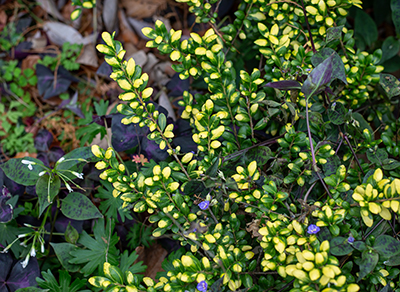
One of the garden beds I love at the Isabelle Cosby Courtyard houses swaths of purples and yellows, and this variegated treat glowed in the afternoon sun. Ilex crenata ‘Drops of Gold’ is one of our few variegated woody plants in the Arboretum collection. These yellow mottled leaves emulate an unfinished paint coat, as if someone had only completed one pass of yellow using a roller paintbrush on the tops of the plants. This splash of color allows the tops of the plants to shine while still providing depth from the dark green beneath. In the winter, the waxy, evergreen leaves make an eye-catching addition to gardens but also wreaths and decor.
Japanese holly is a short but spreading plant, allowing for bulky bed coverage throughout the seasons. As in the Isabelle Cosby Courtyard, perennials easily pop through the branches, allowing for interesting color and pattern combinations. For the most vibrant yellows, be sure to plant this particular cultivar in full sun, but the Ilex crenata ‘Drops of Gold’ otherwise holds up under shadier conditions as well. The plant doesn’t produce much by way of flowers. Similar to the native Ilex glabra, the tiny, white flowers hide amongst the foliage in the spring, and the small, black berries don’t distract from the variegated color display. That being said, ‘Drops of Gold’ is a female clone of a dioecious plant. Ilex crenata won’t produce fruit without both a male and female plant, the male plant providing pollen for the female plant, so it’s possible to miss out on the fruits altogether.