
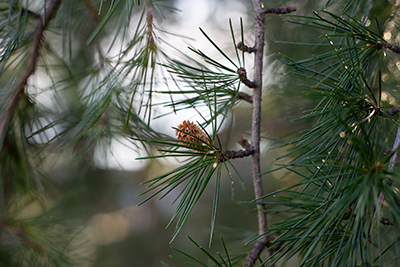
Cedrus deodara – Deodar cedar ‘Roman Gold’
What’s left of the Cedrus deodara male cones confetti the grounds and tree rings north of the Dining and Community Commons. As students tromp from lunch to class, their footfalls smoosh the last puff of pollen like a deflated balloon. Bustling through this side of campus, I found the destruction so delightful that I decided to investigate further.
From there, it’s clear to see how this particular tree captured my attention. Cedrus deodara ‘Roman Gold’ is a beautiful tree. There are a number of specimens on this corner of campus to enjoy – with their counter-balanced, swinging branches, whorled with three-inch, lush green needles, balanced into a tall pyramidal shape vaguely resembling a floppy witch’s hat. This ‘Roman Gold’ cultivar carries golden spring leaves, but its graceful, vertical stature is probably its most attractive feature. And then, of course, the last of the fuzzy catkin-like cones clinging to the branches.
Cedrus represents a genus of plants known as true cedars. Unlike other conifers closely associated with boreal forests, Cedrus species actually prefer warmer climates. Here in the Philadelphia area, we’re at the edge of the C. deodara hardiness zone. C. deodara trees originally hail from the western Himalayan region, where the name “deodar” in Sanskrit roughly translates to “timber of the gods.” Local populations greatly value the deodar cedar timber. Stretching across mountainous forests in Pakistan and northern India, C. deodara wood builds furniture, building reinforcements, and other large-scale construction and carpentry projects. The wood is not only sturdy and rot-resistant but also aromatic and red-tinted.
C. deodara thrives in full sun with plenty of room for its roots and well-drained soils. For best results, Deodar cedar needs deep, fertile soils in cooler areas with high humidity. However, the tree is hardy once an adult. Its drought and heat tolerance have made this tree particularly well-suited for western and southwestern United States climates. Some have even dubbed it the California Christmas tree.
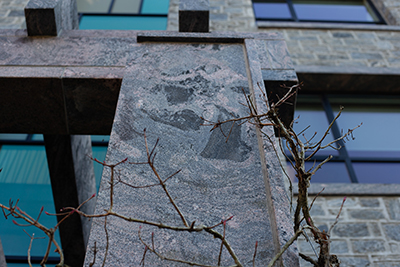
Hydrangea anomala – climbing hydrangea
The snow has fallen. Winter is here. Most people aren’t thinking about their deciduous woody vines that aren’t much more than a naked, brown structure on a wall. Just wait until you’ve seen the vibrant pink buds on this Hydrangea anomala.
In fact, this climbing hydrangea displays a lot of surprising winter interest. The mature bark peels and strips in a reddish hue typically hidden by the flowers and foliage. The winding structure also plays off the schist walls and the marbled texture of the pillar on the North side of Kohlberg Hall that it snakes around. Then stay tuned for the spring leaf out and the summer blooms that usher in their own architectural dance.
Hydrangea anomala is the only hydrangea that climbs. And boy, does it climb. Once established, these plants are well-known for their ability to scale a two-story building within only a year or two. Its scruffy aerial roots easily grasp walls, too, without the need for a trellis or other climbing structure. If you want to and let it, this plant could vigorously and happily become your new building facade.
To sign yourself up for summers maintaining its structure on your own garden walls, plant this climber in full shade to partial shade in fertile, moist, well-drained soils. Plants will also do better in cooler microclimates in this region. White or pale green flowers will bloom in the early summer. Flowers bud from the old wood, so it would behoove growers to avoid pruning except for size and shape control. Although fast-growing and hardy, this plant may take a few years to settle and establish in your soils, during which time the plant will not produce any blooms or much growth.
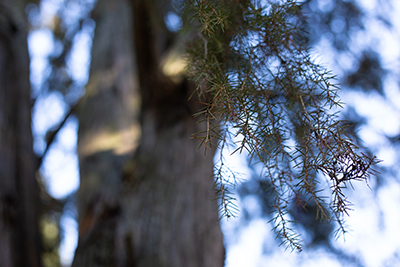
Juniperus rigida – needle juniper
I’ll start by admitting I was first drawn to the bark. After most of the leaves have dropped – I’m not talking about oak leaves – some of the most exciting aspects of the arboretum are the underrated barks often shielded by dense, green foliage. Not the case here. With drooping branches of spiky needles swinging overhead, nothing has changed for Juniperus rigida, but with the allure of bark in the winter season, that’s what I saw first. The overlapping strips of greens and blues and reds and browns bend around branches and knobs like their own wooden river. Patches of lichen and moss highlight these hues like a mottled masterpiece. It’s beautiful and something singular to enjoy.
While not quite the temples where Japanese gardeners typically plant these trees, this needle juniper hugs the corner of western pathways near Wharton Hall. However, situated next to a Juniperus communis ‘Oblonga Pendula’ (common juniper), you can notice some of the distinguishing features between needle juniper and the native counterpart. For one, the needles are closer to the ground. The pokey appendages on the Juniperus rigida hang above and out of the reach of small children.
More often garden retailers will have the ‘Pendula’ cultivar. These branches weep with needles, which can have an interesting effect for smaller gardens in need of winter interest. The trees themselves max out around 20 feet, so it might even perform well closer to a wall. Juniperus rigida prefers average, drier soils in full-sun, and it will handle heat and drought as long as it doesn’t get bogged down in a wet spot. Fruit-like cones on female trees matures from a green to a bluish-black that some birds enjoy in the fall.