
Without leaves on the trees, it’s easy to assume our deciduous trees have nothing going on. However, many bare branches hold winter interest. Here are a few plants that may not have leaves on their branches, but they do have something else.
Magnolia x soulangeana ‘André Leroy’ – saucer magnolia
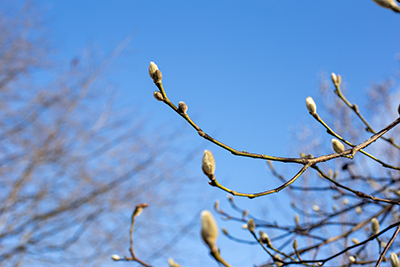
Some magnolias hold onto their leaves throughout the season, but Magnolia x soulangeana ‘André Leroy’ and other saucer magnolias are deciduous. However, their leaflessness adds to their spring charm. This saucer magnolia, along with many other Magnolia species, will be some of the first trees blooming in late March. That early-bird mindset can be partially attributed to their buds. Stark and visible at the tips of the branches, magnolia flower buds are designed for early blooming success. Magnolia x soulangeana flower buds have two thick, hairy scales layered on top of each other. Fuzzy trichomes cover each layer, giving them an extra boost of insulation. Together, these features allow the flower buds to withstand the winter and bloom early in the spring.
However, this early bloom has its risks, too. Early spring frosts can damage the Magnolia x soulangeana flowers so they lose their vibrant, cup-shaped sheen. If possible, avoid planting this tree in a warm, southern spot near a building. The extra warmth that comes from a sunny spot and close proximity to a heated structure can induce early blooming, putting your tree at greater risk of losing flowers to frost. Ideally, this saucer magnolia prefers partial shade with protection from cold, harsh winds. If you’ve got the right spot in the garden, it’s worth the hassle.
Without having too much spring envy, these trees really excel during the blooming season. Around late March, the cup-shaped pink flowers take over the tree. The ‘André Leroy’ cultivar has a deep magenta to white gradient that perks up the garden at the end of winter. It is also known for having a shorter, bushier habit, which might make this plant more ideal for smaller gardens. Magnolia x soulangeana was originally a hybrid cross between M. denudata (Yulan magnolia) and M. liliiflora (lily magnolia) in 19th Century France. Now, there are a range of saucer magnolia cultivars to choose from, so don’t be afraid to explore the shades and shapes for whatever best suits your garden.
Edgeworthia chrysantha ‘Snow Cream’ – paperbush
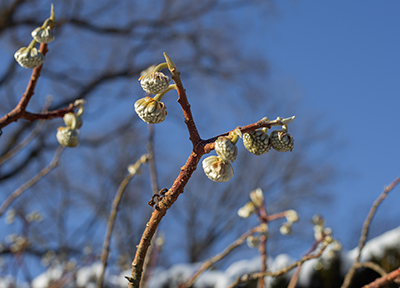
I’ll preface this by saying that I swear I’m not exaggerating for once. The Edgeworthia chrysantha ‘Snow Cream’ branches twinkle with dozens of silver-bell-like flower buds. A shock of silver. Eye-catching, even from a distance. Trust me, they pop in the winter landscape.
Paperbush is another plant to keep your eyes out for in the springtime, too. These delightful baubles transform into adorable, little, yellow inflorescences come April. They also continue to dangle like tiny falling stars upon blooming. With the spring blooms comes another treat: the fragrance. These blossoms give off a sweet, lilting scent described as a mix of jasmine and honey. Its entrancing odor beckons visitors through the early spring garden and provides ample excuse to throw open the second-floor Cunningham House windows.
The plant itself is a rotund shrub, no more than eight feet, which keeps it mostly at eye level for year-round enjoyment. This woody perennial does best in partial shade with moist, well-drained soils, but it’s adaptable as long as it avoids hot, afternoon sun. ‘Snow Cream’ tends to be a fast-growing, somewhat hardier specimen if your garden has a cooler microclimate. Beyond that, it’s a critter favorite. Throughout the seasons, sparrows and chipmunks take up temporary residence among the multi-directional branches.
Perhaps the most odd thing about this plant is its weird nomenclature debate. In the 1800s, two separate researchers submitted a species name for this plant around the same time (E. chrysantha and E. papyrifera), leading to some confusion as to which author had penned the name first. Currently, both are listed as a synonym for E. tomentosa, but search results for E. tomentosa redirect to E. chrysantha webpages. At least it’s not just public horticulture interns who struggle to keep up with scientific name changes. The common name “paperbush” refers to this plant’s history as paper bark for creating quality paper and Japanese banknotes.
Liquidambar styraciflua ‘Slender Silhouette’ – American sweetgum
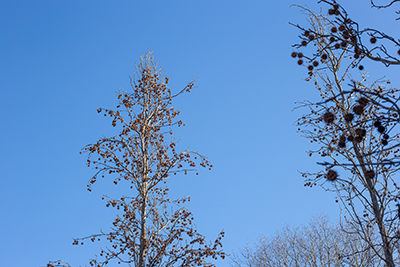
Flower buds aren’t the only thing to spot on a wintering, deciduous tree. These bare Liquidambar styraciflua ‘Slender Silhouette’ branches still bear the identifiable, urchin-like seed pods. Leafless, nothing blocks these uniquely identifiable spiky balls from view. Add the narrow spired shape of this particular cultivar, and the overall look is unexpected and unique.
Liquidambar allegedly gets its genus name from an encounter between Spanish conquistador Hernán Cortés and Aztec emperor Moctezuma II tasting sap from a sweetgum tree. In the account, the recording soldier describes the sap as “liquid amber.” Probably in Spanish, but somehow the Latin name solidified, much like the sap after a week, as Liquidambar. For your own taste of liquid amber, the sap reportedly hardens to a gum if you knock off part of the bark and wait for one week to collect off the wound. This gum, or rosin, has historically been used as chewing gum among indigenous communities. The bark and fruits can also make a palatable tea for experimental tastebuds.
As a child, I often grouped American sweetgum and maples together because of the star-shaped leaves. Alas, they are not closely related. The Liquidambar styraciflua leaves are alternate instead of the opposite formation among Acer species, and American sweetgum actually falls into the Altingiaceae family where they exist as the sole extant genus. For a while, it was included in the Hamamelidaceae family with witchhazels, but that has since been revised following several molecular phylogenetic studies. A 1935 study published in the Journal of the Arnold Arboretum by Edgar Anderson and Karl Sax identified n = 12 chromosomes in every sub-family of Hamamelidaceae except Liquidambaroideae which was n = 15. The slow march of science took its sweet time from there.
Most plants we grow at the arboretum prefer generous growing conditions – average, well-drained, loamy soils with adequate sunlight. L. styraciflua ‘Slender Silhouette’ is no exception, only you don’t want to provide optimal growing conditions. To slow growth, keeping its habit tall and tidy, grow this tree in poor soils and tough spots in your garden, but still in full sun. During the first few years as the plant establishes, provide ample water without overdoing it. The widest the plant should become is 5 feet.