
Plants of the Week by Caelon Shugrue, Public Horticulture Intern
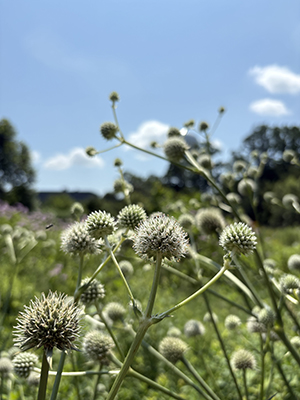
Eryngium yuccifolium – rattlesnake master
With stunning spiked globes for flowers, Eryngium yuccifolium is sure to catch your eye – it sure caught mine as I was strolling through the Whittier meadow. While it may look similar to a thistle, rattlesnake master is a member of the carrot family, containing many of the same oils and secondary compounds found in parsley, carrot, and parsnip. Break and crush a leaf and you smell the similarities!
Rattlesnake master can grow up to 6 feet tall in optimal sites. It is drought tolerant and thrives in full sun with sandy soils. Growing rattlesnake master in your garden would provide an interesting variation in texture. As an herbaceous perennial, it can be planted in shrub borders and also fits well in meadow plantings.
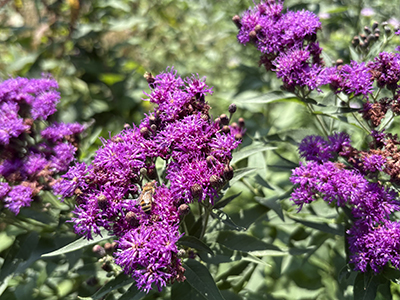
Vernonia baldwinii – Baldwin’s ironweed
Buzzing with pollen-covered bees, Veronia baldwinii sports deep purple flowers clustered in corymbs. These blooms last from late summer to early fall and attract bees, butterflies, and curious plant-enthusiasts. Once the flowers are done, they give way to rusty-colored seed clusters. These rusty-colored seeds, in addition to the rusty tinge in the fading flowers and the tough stems, give the plant certain “iron-like” qualities, hence the common name “ironweed.”
Also found in the Whittier meadow, Baldwin’s ironweed can grow in most conditions, whether moist or dry. It is native to Missouri where it can be found across the state in woods, meadows, prairies, glades, fields, and disturbed areas. It is very successful in self-seeding and is thus easily grown from seed.
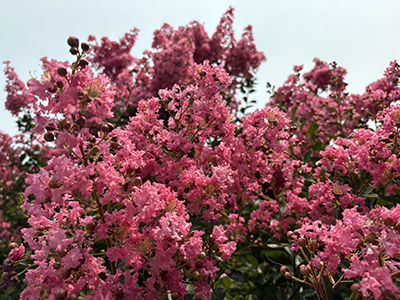
Lagerstroemia ‘Hopi’ – hybrid crapemyrtle
Found tucked away in the Lilac Collection, this hybrid crapemyrtle stands out due to its stunning, hot pink blooms. Wild crapemyrtles are red or rose-colored, but many cultivated varieties have been developed with new flower colors including white, pink, mauve, purple, and lavender. Originally native to the Himalayas, crapemyrtles have been naturalized in the U.S. as far as Florida and Arkansas. In addition to its impressive flowers, crapemyrtles have interesting multicolored, exfoliating bark.
The ‘Hopi’ cultivar is one of many mildew-resistant hybrids developed by the National Arboretum in Washington D.C., which named these cultivars after Native American tribes. The Hopi tribe has a reservation in Hopitutskwa, located in northeastern Arizona.