
Guest author: Katrien de Waard, 2025-2026 Public Horticulture Intern
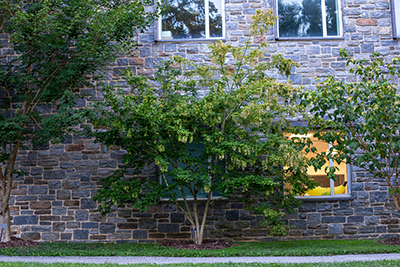
Acer henryi – Henry’s maple
We have a plethora of native maples that dazzle the fall foliage scene; drawing attention alongside the feathery threadleaf Japanese maples. However, I was really astonished by the dangling droops of samaras on the Acer henryi (Henry’s maple) slotted between the Science Center and Whittier Place. Like yellow-green wisteria dangling from the branches, these dry fruits glow from their eye-level perches.
As a kid, I didn’t know much about plant identification, but I knew a lot about the maple trees in my front yard. The line of Acer rubra (red maple) crowded the dirt between the sidewalk and the street. The monstrous Acer platanoides (Norway maple) shaded the whole yard, easily one of the largest and oldest trees in the neighborhood. That Norway maple was a defining feature of my childhood, and yes, it’s invasive, and yes, every year it loses a limb, but I will still miss that tree when someone finally yanks its roots out of the ground.
Henry’s maples don’t quite invade our built environments like Norway maples. Having been introduced more recently as an ornamental tree, you’ll rarely find them outside of a garden. These trees are named for the Irish plant collector and medical doctor Augustine Henry, who studied medicinal plants in China in the 1880s. These Chinese natives of the Hubei and Sichuan provinces don’t have quite the allure of their Asiatic neighbors, the Acer palmatum (Japanese maple). However, it is a delightful, scraggly tree to make your acquaintance. Not to be confused with – but often confused with – Acer cissifolium (ivy-leaved maple), Henry’s maple has much smaller, spike-like inflorescences and sandstone-red new stem growth compared to the ivy-leaved maple’s striking yellows.
Reportedly hardy to Zone 5, these deciduous trees can reach a bushy 30 feet, but they don’t naturally have the shady habit of my childhood trees. They’re highly versatile plants, growing happily in sun, shade, moist, dry, and in a range of other soil environments. Similar to the Acer negundo (boxelder), Henry’s maple has mostly untoothed leaf margins in clusters of three, that can look like poison ivy as a sapling.
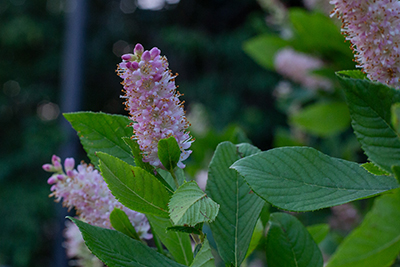
Clethra alnifolia ‘Ruby Spice’ – summersweet clethra
In these final few days of July, catch the mighty full blooms of summersweet clethra sprinkled around campus. Bumblebees buzz all along the bloom spike. The dainty bouquet of flowers poke out of the thick deciduous shrub leaves, appearing almost as fuzzy as their pollinating friends. If you’re patient, sitting quietly out of reach, you may even see a wayward butterfly or hummingbird flit amongst the flowers on their hunt for nectar. This cultivar ‘Ruby Spice’ – spotted in front of Mertz Hall – flirts with pink hues, similar to my nearly washed-out pink hair dye.
This summer has been particularly kind to Clethra alnifolia with our happy helpings of rain. This plant loves to get its feet wet in poorly drained, moist soils and enjoys extended, multi-year vacations to the eastern coast of the United States from Florida to Maine (although, not directly on the beaches. It has salt-tolerant standards). Once established, this summersweet clethra will grudgingly tolerate slightly drier conditions, preferably in more acidic soils. Unlike many other shrubs, Clethra alnifolia happily blooms in August when situated in shadier spots. If you’re looking to fill a cozy little plot, perhaps a little damp, perhaps a little shaded, this deciduous shrub might be just the right speckle of fragrant floral buzz to perk up the late summer pollinators.
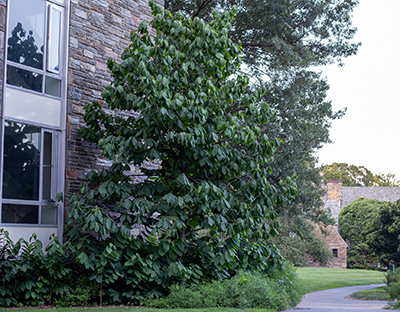
Asimina triloba – common pawpaw
Backed up against Willets Residence Hall is one of the few pawpaws on campus. Its bushy branches and floppy foliage typically fill in pockets of the understory on the forest edge or cluster in shrubby bunches on a riverbank. The pawpaw doesn’t mind getting its feet wet in well-drained soils, and it’ll fruit the best when glowing in the sunshine.
I can count the number of times I’ve eaten a pawpaw on one hand. It’s not a commercially grown fruit you’ll find in the grocery store, or even a highly-prized treat at the farmers market. Often, squirrels and other critters swipe the fruit before humans get to them, or their easily-bruised skins batter their tasty pulp. A pawpaw tree also doesn’t self-pollinate; they need genetically-different neighbors to make fruit, and that can be a tough bargain for gardeners looking to plant a pawpaw on their property. Two trees? In this economy?! That being said, our fruit and vegetable consumption complacency must be addressed. Life is too short to limit your pallet of edible foods to the two dozen vegetables found at your local Giant. Why not try a pawpaw! Once you become familiar with their identifiable leaves, you’ll see them popping up on your streambank walks, bearing ripe fruit if you’re lucky. I will warn you, however, to be careful to avoid the poisonous skin and seeds when consuming this fruit.
In my case, I can confidently say that I have had pawpaw ice cream (as of Thursday last week). For his final summer as a horticulturist here at the Scott Arboretum & Gardens, Lars Rasmussen whipped up his renowned pawpaw ice cream. For weeks, I’d been hearing the same thing, “You have to get Lars to make his pawpaw ice cream.” And lo and behold on a hot day weeding under the magnolias, Lars swung over to the interns to ask which day would work best for our schedule. The anticipation sizzled. For those who haven’t been blessed with the sweet respite of pawpaw ice cream during a much-needed break from the summer heat, imagine the sweet amalgamation of banana, cantaloupe, and mango.
I now confidently call myself a pawpaw fan. Thank you for the ice cream, Lars, and enjoy retirement!