
Guest Author: Olivia Colangelo, 2025 Summer Horticulture Intern
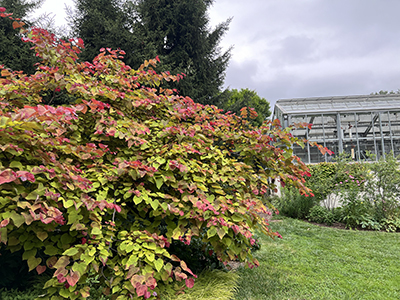
Cercis canadensis [Flame Thrower®] ‘NC2016-2’ – eastern redbud
This incredibly bright red plant was one of the first specimens to catch my attention when I started my summer internship at the Scott Arboretum & Gardens. It was hard to miss the bright red and orange leaves amid the sea of green summer foliage. This fiery-hued tree is known as the Flame Thrower® eastern redbud, or Cercis canadensis ‘NC2016-2’ if you’re fancy. It is located in the Terry Shane Teaching Garden behind the Cunningham House, so you can’t miss it! It can grow 20-30 feet tall, often with multiple trunks. The gradient of yellow to red as the leaves cascade down the branches truly looks as though the tree is sending out streaks of fire. I think we can agree this cultivar is named perfectly. Not only can you enjoy this tree for its foliage, but it also blooms in early spring with gorgeous pea-like pinkish flowers.
This particular cultivar of eastern redbud comes from a cross of Cercis canadensis ‘Ruby Falls’ and Cercis canadensis [The Rising Sun®] ‘JN2’. Incidentally, we have both of those species right here at Scott Arboretum. They can be found south of Pearson Hall and to the southeast of Whittier Hall, respectively. If you’d like to “meet the parents” so to speak, feel free to visit them and see where this unique redbud gets its genetics from. My favorite season by far is fall, due to the assortments of reds, yellows, and oranges found on the trees and shrubs. I believe this is why I was so drawn to this eastern redbud. It gives a much-needed taste of the fall foliage to hold yourself over through the spring and summer.
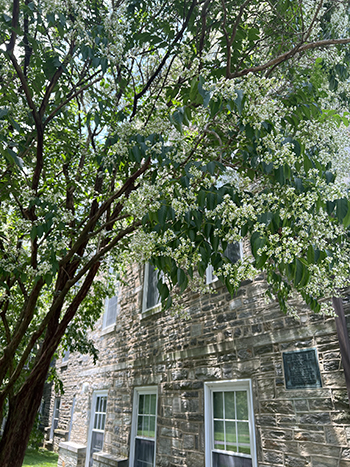
Lagerstroemia subcostata var. fauriei ‘Townhouse’ – Japanese crapemyrtle
What initially caught my eye about this tree was the unique bark; a smooth, light cinnamon color with a peeling pattern that reveals a dark maroonish underlayer. The owner of this strange-looking bark is Lagerstroemia subcostata var. fauriei ‘Townhouse’, also known as a Japanese crapemyrtle. This tree loves full sun, and is located in the perfect position in front of Trotter Hall where it can sunbathe all day! As my eyes traveled up the tree, I was delightfully surprised to find glossy, emerald-green leaves and beautiful white flowers that were just starting to bloom. Even without its blooms or leaves, it still has enough winter interest with its distinctive bark to continue captivating viewers. These blooms will continue through August, so it is the perfect time to come see this beautiful tree with your own eyes.
The Japanese crapemyrtle truly has so many interesting visual characteristics, but aside from its physical beauty, it is also a Heritage Tree here at the Scott Arboretum. This crapemyrtle was planted on July 19, 1992. It has been here before the first text message was sent (December 3, 1992), which is incredible to think about. You’ll have to come see this exquisite Heritage Tree and its unique bark for yourself. The tree has been expecting you since 1992, don’t keep it waiting any longer!
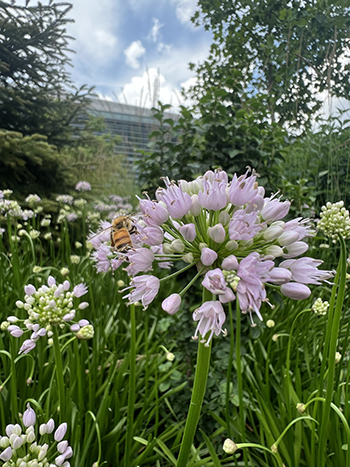
Allium ‘Summer Beauty’ – Portuguese allium
As I walked through the John W. Nason Garden, there was an allium species just starting to bloom. Full transparency, I noticed this particular plant not for its flower or foliage, but for the little bee that whizzed by me to sit atop it. This allium only grows up to 18 inches tall, so if not for that bee, I might not have looked down in the first place. However, I’m glad the bee encouraged me to notice this gorgeous flower with beautiful, light-purple blooms. The tiny, lavender-colored blooms create a sphere, which makes this flower look straight out of a fictional story. The shape reminds me of the flower that houses Whoville, from ‘Horton Hears a Who.’ It was a good reminder to look at all height levels while in a garden, because you never know what might be hiding in plain sight.
This particular allium grows on the shorter side, ranging from 9-18 inches tall, making it the perfect specimen to put in the front of your garden. It can add some visual interest without the worry of the plant growing too tall and blocking what’s behind it. Many alliums, including this cultivar, emit a strong oniony-garlic fragrance. In fact, many alliums are commonly referred to as ornamental onions. The scented leaves mean this allium can add both visual and aromatic interest to any garden. You might tend to gravitate towards taller species of alliums, such as those found in the Dean Bond Rose Garden. However, let’s not forget about the little guys. After all, Horton says, “a person’s a person, no matter how small” and I think we can apply that to plants as well. Make sure to stop by the Nason Garden to give these small but mighty alliums their fair share of attention.