
Plants of the Week by Caelon Shugrue, Public Horticulture Intern
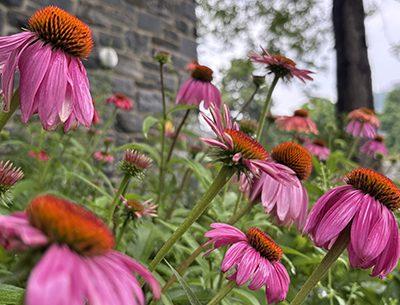
Echinacea ‘Cheyenne Spirit’ – coneflower
Blooming in a variety of colors, Echinacea ‘Cheyenne Spirit’ flower can be purple, pink, red, orange, yellow, cream, or white. This specific cluster at the entrance of the Pollinator Garden – found between Cornell Library of Science & Engineering and Martin Hall – attracted me due to its wide range of hues from dusty orange to bright purple. The dried cones can remain into the winter and are often visited by birds such as goldfinches that feed on the seeds. In addition to birds, deer have also been known to snack on the new growth.
Echinacea ‘Cheyenne Spirit’ is relatively easy to grow, enjoying full to partial shade and dry to medium moisture. As herbaceous perennials, it is tolerant of drought, heat, humidity, and poor soil conditions. These Echinacea can be planted in rock gardens, perennial borders, or almost any garden with sun. They are quite attractive when planted in groups; however, they can reseed themselves and often become overcrowded.
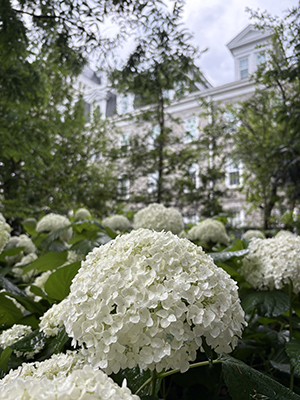
Hydrangea arborescens ‘Annabelle’ – smooth hydrangea
Walking through campus, Hydrangea arborescens ‘Annabelle’ immediately caught my eye due to its huge, round, stark-white blooms. These flower structures (called corymbs) can bloom for up to two months in the summer, sometimes featuring a repeat bloom in the fall. The ‘Annabelle’ cultivar is characterized by having larger flowers than the straight species. This cultivar is a naturally occurring cultivar that was discovered in the wild near the town of Anna, Illinois.
Hydrangea arborescens ‘Annabelle’ grows best in partial shade with medium moisture, and while it tolerates full sun it would require constant moisture. These specimens are located between Parish Hall and the Lang Performing Arts Center and bask in the shade of the dawn redwoods. Flowers bloom on new wood, so to promote an ideal form plants can be pruned back almost to the ground in late winter. Hydrangea arborescens ‘Annabelle’ looks best in mass or group plantings making up a shrub border or as a background for a perennial border.
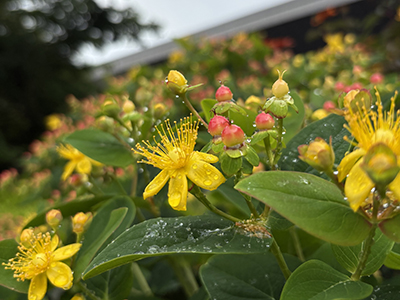
Hypericum × inodorum ‘Allgrandeur’ – Miracle® Grandeur St. John’s wort
The deciduous shrub Hypericum × inodorum ‘Allgrandeur’ struck my fancy due to the vibrant yellow flowers and bright red berries that stick out against its dark green foliage. Planted at the entrance of the Harry Wood Garden, the mass of foliage, bright yellow flowers, and glowing berries draw visitors into the garden. While this plant is very attractive for birds and butterflies, it does not attract deer, who have no interest in the plant.
Hypericum × inodorum ‘Allgrandeur’ grows in full to partial shade and does best in dry to average moisture. It is drought tolerant and will die in standing water. Hypericum × inodorum ‘Allgrandeur’ is also tolerant of most soil pH levels and is tolerant of pollution, allowing it to thrive in city landscapes. It can get quite tall (over two feet) and therefore it is best used in mass plantings, as hedges, or in containers. If growing Hypericum × inodorum ‘Allgrandeur’ in a container, it may require more frequent watering.