
Plants of the Week by Caelon Shugrue, Public Horticulture Intern
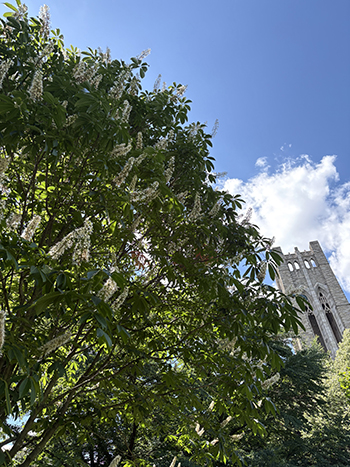
Aesculus chinensis var. wilsonii – Wilson’s horsechestnut
Native to northern China, Aesculus chinensis var. wilsonii has stunning branched clusters (also known as panicles) of white, slightly aromatic flowers. Wilson’s horsechestnut is mostly grown ornamentally. In fact, its seeds were collected and distributed due to these showy blooms. They first arrived in the United States when British botanist William Purdom sent saplings to the Arnold Arboretum in Boston from seeds collected in Beijing.
After the panicles of flowers –which can be as large as 16 inches long– bloom from May to June, dry dehiscent fruits form. At maturity, the husks of these fruits open (or dehisce) in early fall to release 1-inch nuts. Beware, these nuts are slightly poisonous due to the abundance of saponins, which can be successfully leached out through a rigorous process of cooking or washing. These nuts have historically been used in traditional Chinese medicine to treat shortness of breath and abdominal pain.
In China, Aesculus chinensis var. wilsonii grows in forests, thickets, slopes, ravines and roadsides. Thus, this tree is planted in places where it enjoys full sun to partial shade and well-draining soils. It can be used as a shade tree in many gardens or a street tree, but cleaning up after its nuts may seem tedious. This specific specimen is planted on the quad between Sharples Commons and Clothier Hall, where it basks in partial shade. Its eye-catching flowers and nuts add an interesting texture and feel to the landscape.
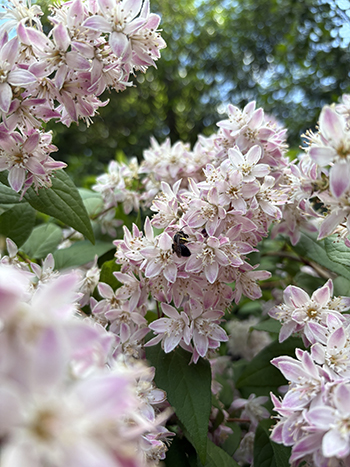
Deutzia x hybrida ‘Magicien’ – hybrid deutzia
Also with large clusters of flowers, this hybrid deutzia produces showy pink and white flowers from late spring to early summer. Adored by Scott Arboretum & Gardens horticulturists, visitors, and bees alike, this beautiful Deutzia has gorgeous, star-shaped flowers. It caught my eye because around this time of year it seems as though the Deutzia has more flowers than leaves.
This hybrid is a cross between two Asian species of Deutzia: D. longifolia and D. discolor. Rapidly growing and with beautiful, showy flowers and bright, green foliage, this plant is ideal for planting along shrub borders or mass plantings. This specimen is found on the edge of the path by the Cunningham House – calling visitors to the entrance garden or perhaps wishing them farewell.
Most flowers are produced when the plant is in full sun to partial shade with nutrient rich, moist soils. This shrub typically grows as tall as four to six feet with a similar spread, but regular prunings are recommended to keep it from looking unkempt. The hanging clusters of flowers are eye-catching in bloom, and the fall foliage is a pleasant red. Perfect for a shrub border or a hedge, this Deutzia is sure to spruce up any garden.
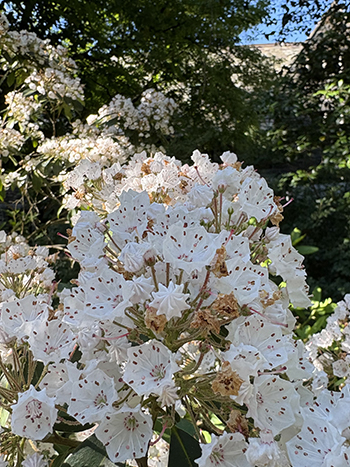
Kalmia latifolia – mountain-laurel
The state flower of Pennsylvania and Connecticut, the mountain-laurel blooms in late spring to early summer with striking geometric flowers. With many cultivars available, its flowers can range from pink to white to red or all three! The anthers in the flowers have an interesting pollen dispersal adaptation – when touched by a bee, the anthers spring out of their pockets in the petals and fling dustings of pollen on the pollinator.
As a member of the Ericaceae family, Kalmia latifolia is best grown in acidic soils. Native to eastern North America, this plant is found in a variety of landscapes such as rocky or sandy woods, meadows, and mountain slopes. In planted landscapes, this shrub is often used in shrub borders as it can spread vigorously. Its flowers are quite showy, and as an evergreen shrub, it has excellent year round foliage. Eaten in abundance, the leaves are poisonous but that doesn’t stop deer from enjoying a bite or two.
Kalmia latifolia has dramatic, gnarly branches adding an interesting dimension to any landscape. One of its common names “spoonwood” is a reference to the fact that woodworkers today and in the past have used this wood to make spoons or bowls. Often identified by its branches, Kalmia latifolia bark is rigid with pieces plaited and often hanging or peeling off.