
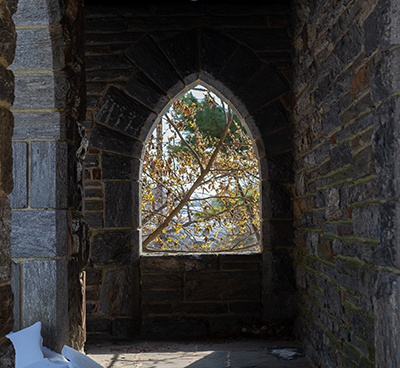
Must be the season of the witch because our witchhazels have finally bloomed. Across campus, winter-blooming witchhazels can be spotted by their unique, confetti-like flowers sprouting off the branches like a fungal disease.
Only five species of Hamamelis exist, and we currently have at least one of each on campus: Hamamelis japonica (Japanese witchhazel), H. mollis (Chinese witchhazel), H. ovalis (bigleaf witchhazel), H. vernalis (vernal witchhazel), and H. virginiana (common witchhazel). Only H. virginiana is native to our region of North America. While common witchhazels bloom in late October in the Crum Woods, our other witchhazel species bloom in the winter months. These brightly-colored flowers speckle the landscape with a shock of color and provide a sweet nectar treat to the many flies, wasps, and moths bumbling about outside of the typical growing season. With little else blooming, witchhazels don’t have to compete; they only have to lure in their pollinators.
Despite their vibrant color and bountiful nectar, people once believed that witchhazels were wind-pollinated. Their fragrance is another key indicator that witchhazels rely on insect pollinators to fertilize. Witchhazels have a cloying, sweet scent once described to me by a Swarthmore community member as “floral.” Ideally, prune your witchhazels after they bloom, but a few cut branches can lift a room with their aroma.
Outside of the blooming season, Hamamelis can most easily be identified by its leaves. Each leaf has a wavy, scalloped margin with an uneven base, and oftentimes leaf galls protrude from the tops too. Many of our witchhazels also have an upside-down pyramidal shape. In the woods, this form would be advantageous to maximizing captured light as photons filters through the canopy.
While witchhazel is a fascinating common name, its origin has nothing to do with the cackling, broom-riding characters from fantasy stories. “Witch” likely comes from the old English word wych, meaning “to bend.” Like an old-fashioned dowsing rod, users searched for hidden, underground water deposits with the sticks. The witchhazel branches made ideal dowsing sticks because of their forked, y-shape. Dowsers believed that the branches would bend towards the ground upon discovering water sources although no scientific evidence supports these claims.
People have also used witchhazels for medicinal purposes for centuries. Native Americans used the bark and twigs to treat anything from colds to insect bites. Since the 1850s, several companies have specialized in producing witchhazel extract, which you can find today in numerous lotions, toothpastes, and soaps. Some studies found anti-inflammatory benefits when the witchhazel extract is applied to the skin, with demonstrated effectiveness against some bacteria and fungi.
Witchhazels will continue to bloom for the coming weeks. I’ve highlighted a few of the early-blooming species and cultivars that will soon be past their prime but leave a wondrous fragrance in their wake.
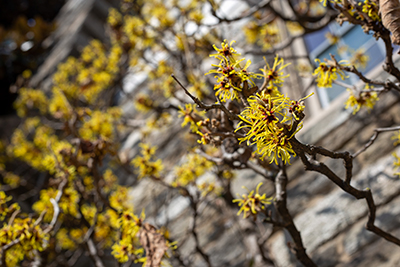
Hamamelis mollis ‘Early Bright’ – Chinese witchhazel
We have a number of ‘Early Bright’ Chinese witchhazels around campus. In the peak of the winter cold, these plants resolutely flowered in all of these nooks and crannies. The spindly flowers are a bright yellow, and they popped out by the end of January even amidst the freezing temperatures and snowfall. Its distinctive sweet scent wafted through the Fragrance Garden where you can spot a unique espaliered version of this tree. Through the stone windows across from the Gender and Sexuality Center, the vibrant petals also catch the sunlight.
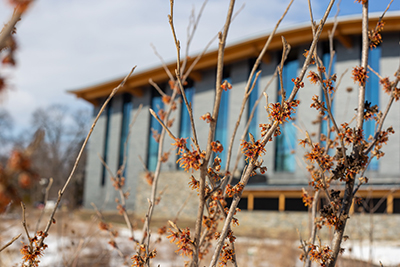
Hamamelis x intermedia ‘Jelena’ – hybrid witchhazel
Crosses from H. mollis and H. japonica plants created our Hamamelis x intermedia (hybrid witchhazel) trees. They tend to bloom earliest in the season, signalling the start of the witchhazel bloom period. A number of our cultivars also have gorgeous colors. A bit off the beaten path, this hybrid witchhazel ‘Jelena’ boasts a gorgeous combination of oranges, yellows, and purples in the bed south of the Dining and Community Commons. At this point in the season, the petals have seen better days, but it’s a flower to await next winter.
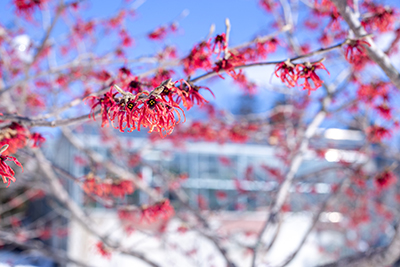
Hamamelis x intermedia ‘Diane’ – hybrid witchhazel
Another hybrid witchhazel, I checked Hamamelis x intermedia ‘Diane’ every morning on my way into work. Throughout the week, the petals cautiously unfurled, finally settling into their stunning display on the slopes behind the Wister Center. The unusual purples and pinks make this cultivar particularly exciting in the landscape and distinguish itself from most other Hamamelis cultivars that generally fall closer to yellow shades and tones.