
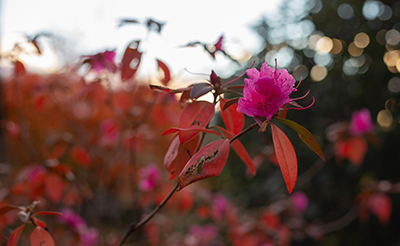
Rhododendron ‘Milestone’ – rhododendron
The Harry Wood Garden is a cove of striking pinks and deep greens at the moment, and nestled between the dense foliage, the Rhododendron ‘Milestone’ glows. Its delicate pink flowers, one strong puff from disaster, have clung to these branches through willpower and a lightning strike of potentially favorable environments. You might be thinking, Don’t rhododendrons bloom in the spring? And you would be right. This late-blooming, rusty Rhododendron does typically bloom in the spring, from early-May to mid June. ‘Milestone’ is not an exception. However, sometimes rhododendrons will bloom in the fall due to a number of uncontrollable factors: a timely rainstorm after a drought, highly stressful conditions, or in certain areas of the world, La Niña.
Rhododendrons have long been prized as ornamental shrubs. Dubbed “the tree of roses” in Greek, over 1000 wild species populate the planet with their spring blooms, and hundreds more cultivars occupy gardens around the globe. Most cultivated rhododendrons are hybrids, having cross-pollinated and left their species names behind. Its petals have been used to make tea, its leaves for essential oils, and its fine-grained wood for a number of tools and furniture. Weston Nursery developed Rhododendron ‘Milestone’ to withstand the northeastern climates of Massachusetts, making this cultivar particularly hardy to colder zones.
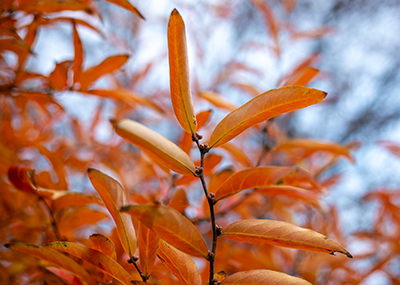
Lindera angustifolia – willow-leaved spicebush
Perched atop the Biostream, this Lindera angustifolia holds on to its shining fall color like a cozy autumn bonfire. Amidst the rusting reds and souring yellows, these bell pepper orange leaves could truly embody a burning bush. The fall color won’t last much longer as the shades shift to a dusty brown, but the leaves themselves might cling to the branches through the winter months and into the spring. L. angustifolia may change colors, but it doesn’t quite lose its coat. The leaves themselves are year-round fun, with their oblong, lanceolate shape and their glossy, vibrant texture. Place this plant in a spot of your garden that could use a little autumnal pop of color.
If you’re looking to plant your own L. angustifolia, this plant has a multi-stemmed, bushy habit with plenty of texture and an aroma in the summer spiced just enough to deter deer predation. L. angustifolia can also scale fellow trees and buildings, which could add some character to your garden. This plant is adaptable to most gardens but prefers sandy, moist spots in the sun. The North American native Lindera benzoin doesn’t have quite the shock of showy color or leaf shape of its Asiatic counterpart, but it does have delightful flowers decorating its early spring branches that resemble Hamamelis blooms.
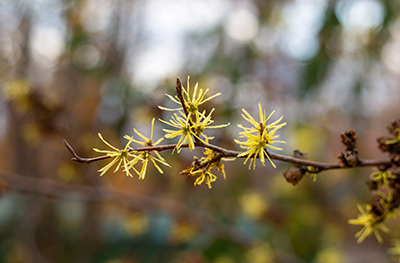
Hamamelis virginiana ‘Harvest Moon’ – common witchhazel
We may have passed the Harvest Moon (October 6, 2025), but it’s never too late to celebrate the Hamamelis virginiana ‘Harvest Moon’. This common witchhazel gets its cultivar name from its late-blooming flowers, showing off its spooky splendor when little else is blooming this close to winter. Hamamelis virginiana consistently takes the prize as one of the last native plants to flower in the northeastern United States.
The genus name Hamamelis refers to the flowers and fruit appearing on the tree at the same time (Hama meaning “same” and melon coming from the Greek word for fruit), which is especially true for fall-blooming Hamamelis species. The life-cycle of these fruits are quite unique. The pollinated ovary enters a resting state during the winter and only begins fertilization in the spring, five to seven months after pollination. The fruit reaches maturity over the course of the summer into small green capsule dries and splits, rocketing the seeds like a cannon in late October. Just in time for the new flowers to appear! The seeds then lay dormant for two winters before sprouting.
One fall semester of college, I took a field biology class which involved tree identification. By the time we were quizzed on any of the plants, we all had to get really good at bark identification except when it came to common witchhazel. In the spring and summer months, this understory tree is delightful if unassuming, but its bizarre flowers have always been an autumnal, woodland gift. Older botanical references claim this tree is wind pollinated, but in actuality, these flowers are siren songs for moths, bees, flies, beetles, parasitic wasps, leafhoppers, and a number of other desperate critters looking for a late-season snack. In particular, you can find winter moths like witchhazel dagger moths (Acronicta hamamelis) and their larvae are known to feast on the sap and seeds. Its primary pollinators, though, consist mainly of flies and wasps.
‘Harvest Moon’ occupies a hidden pocket near the Glade, pinned between the Whittier Place backroad and the Science Center. While Hamamelis virginiana tolerates a range of shady conditions, the plant flowers best and grows larger in sunnier locations. Soils should be moist and well-drained, especially when establishing the young tree, preferably with slightly acidic and organically rich characteristics. This plant makes a great addition to a naturalized garden, winter garden, or rain garden, especially with a woodland focus.