
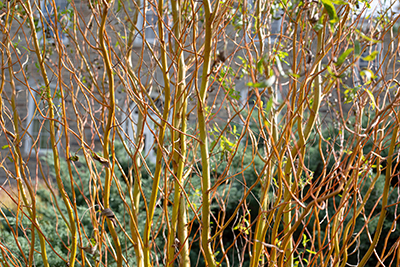
Salix ‘Swizzlestick’ – corkscrew willow
There are plenty of ways to enjoy fall color at this time of year, but if you’re looking for a unique twist to yellow right now, Salix ‘Swizzlestick’ delivers. The last of the thin, rough leaves cling to the ends of the branches, but the leaves are merely the curling, green, serrated icing on the metaphorical cake. At this time of year, the branches themselves really pop. Ranging from highlighter yellow to pumpkin orange, the vibrant bark holds a 2b curl with ease, bending in a slight corkscrew, spiralling upwards like a ballerina in a music box. It’s unusual and, in its oddity, exciting. At the moment, this tree makes quite the statement framed by conifers in the John W. Nason Garden.
Salix has an estimated 350 species, most native to the cooler climates of North America and Eurasia. Although its origin is unclear, Salix ‘Swizzlestick’ heartily handles winters in Zones 5-8. There’s plenty of winter garden potential for mid-Atlantic green spaces, but for maximum swizzle branching, make a hard cut back in late winter every few years as the plant gets larger to encourage new growth. ‘Swizzlestick’ enjoys sunny, well-watered sites but is otherwise not too picky. It will happily tolerate high salt concentrations, moist environments, and low soil quality. Salix species are great for erosion control, and they’re often found in the wild along banks and water edges.
The original swizzlestick tree is Quararibea turbinata, a Caribbean understory tree growing up to 18 feet tall. These plants also have a slight bend to some of their branches, but the real swizzling comes from its nodes – points on the stems where multiple branches shoot outwards like wheel spokes. These spoked sticks have allegedly been used for rum cocktails to mix ingredients.
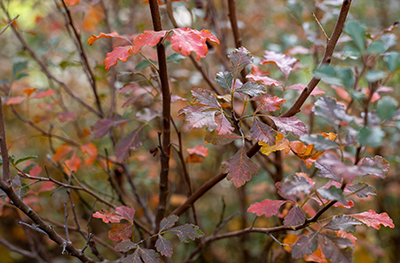
Rhus aromatica‘ Fine Textured Compact Select A’ – Lacette™ fragrant sumac
In terms of eye-catching color, Rhus aromatica ‘Fine Textured Compact Select A’ might not be your first thought, but as the leaves have slowly eked gradients of copper reds, the shrub looks magical right now. The leaves have a fun, pastel sheen to them as the greens, rusty purples, and brick reds mottle together. This Lacette™ fragrant sumac blesses its browning bed at Dan West House. The dark, reddish-brown bark compliments the speckled leaf senescence slowly creeping up each branch, dripping scarlets and plums up the dying greens.
This Rhus aromatica also easily tolerates our environment and all its conditions. ‘Fine Textured Compact Select A’ enjoys anything from full sun to partial shade. Although usually grown on the drier side of soils, it doesn’t mind a little rain. The main issue is poor drainage where Rhus aromatica doesn’t like to soak for too long. The ‘Fine Textured Compact Select A’ is particularly noted for its drought tolerance, so definitely lean into the absence of water when established for best results. This shrub works excellently as a collection, stabilizing sloped conditions and forming a delightful, colorful mass. Its species name highlights the light, lemony scent the leaves emit when crushed, but the plant isn’t otherwise too scent-forward.
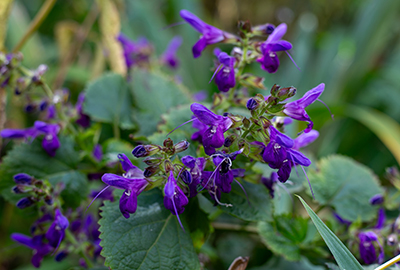
Salvia glabrescens ‘Shi-Ho’ – Japanese woodland sage
In autumn, we’ve got colorful branches, colorful leaves, and – would you believe it? – colorful flowers, too! Salvia glabrescens ‘Shi-Ho’ fills that gap. These initially unassuming plants nestled along the shaded walkways by the northern corner of Trotter Hall are speckles of violet sprinkled amidst the green foliage. The late-blooming flowers beckon the last of the bees and butterflies with very little competition. This Salvia hails from the Japanese island of Honshu and survives over winter as a perennial in the Philadelphia region. Despite its common name Japanese woodland sage and its membership in the Lamiaceae family, the plant doesn’t have much of a scent compared to its fun-smelling brethren. True to its name however, ‘Shi-Ho’ perfectly dots woodland environments in partial shade and moderate soil conditions.