
Plants of the Week by Caelon Shugrue, Public Horticulture Intern
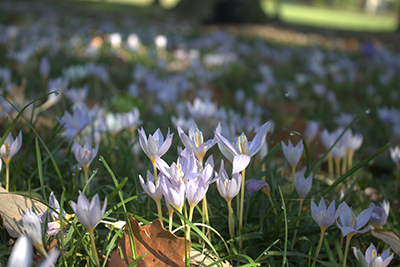
Crocus speciosus – large autumn crocus
Walking down Magill walk at the base of the Pinetum you might see something that looks like petals scattered across the grass. However, as you get closer you’ll realize there are actually hundreds of Crocus speciosus flowers emerging from the grass. If you bend down, and really take a look, you can see the delicately veined petals and the feather-like branching of the stigma. Crocuses are one of those plants that really needs to be admired up close, to see the honeybees pollinating the flowers or ants dispersing the seeds.
Crocus speciosus has been grown ornamentally for years in the United States but it is actually native to the Caucasus Mountains, Southeast Bulgaria, the Krym Peninsula in Russia’ and Northern Iran. In its native habitats, and here in Pennsylvania, it survives freezing temperatures due to its underground corms that store nutrients over winter to push out new foliage in the spring. Plants that have these underground storage structures like tubers, bulbs, or corms are known as geophytes. Other geophytes include Solanum tuberosum, commonly known as potatoes, and Narcissus, or daffodils (which are classified as having “true bulbs”). The nutrients that geophytes store make for delicious snacks – potato tubers are dense reserves of starch!
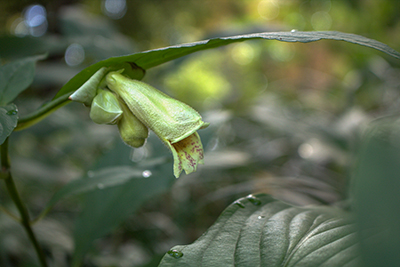
Hemiboea cavaleriei – Cavalerie’s hemiboea
The African violet family Gesneriaceae is a large genus of flowering plants found in mostly tropical and subtropical biomes and is often cultivated as houseplants. Hemiboea cavaleriei is a member of this family and is actually winter hardy – surviving the harshest of our Pennsylvania winters. Creamy white, tubular flowers rest under leaves, with wide open mouths beckoning pollinators in. Miniscule hairs cover the outside of the petals and inside are dark purple speckles. This is a short plant, growing around 2 feet tall, but it can spread up to 7 feet wide. Located in the Cherry Border, this plant blooms around October and in many places lasts until the first frost. This particular species of Hemiboea is native to Southern China and Vietnam, where it lives in rocky, calcium carbonate-rich mountain forests.
The Hemiboea genus of shrubs and flowering plants in the African violet family. Millions of years ago, these plants originated in karst landscapes and have diversified many times from there – making it a group full of diverse phenotypic adaptations. Karst is a type of landscape composed of limestone, a very soft rock that dissolves in water. As it rains, the limestone erodes and creates caves, fissures, underground streams, and sinkholes. On the surface, this erosion reveals steep, rocky cliffs. These highly fragmented habitats are one of the reasons for the high diversity of the Hemiboa genus. These landscapes offer unique niches for plant adaptations to develop and provide spatial separation that isolates plants in their specialized environment.
Karst landscapes are further characterized by periodic water deficiency, poor nutrient availability, and low soil water content. To protect the buds (and thus the reproductive potential of the plant), some Hemiboea species surround buds with bracts and fill this “womb-like” structure with a fluid. This fluid may act as a protective measure against environmental stressors, ensuring water and calcium availability. Hemiboa cavaleriei is a rare and interesting plant to have in a collection with an exciting family history. Be sure to check this one out!
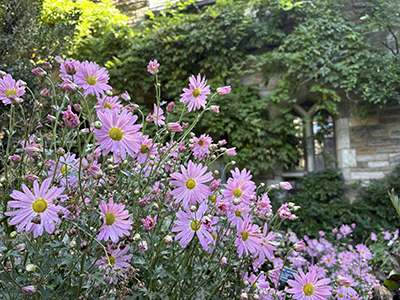
Chrysanthemum rubellum ‘Clara Curtis’ – hardy mum
Lighting up the peony garden with bright pink, this late-blooming hardy mum demands your attention. This is a hardy perennial that was cultivated to form mounds or clumps of showy pink flowers in your garden. Chrysanthemum rubellum is native to Eurasia, Indo-China, Canada, and Alaska. Adapted to climates with intense winter months, these perennials will survive the cold conditions typical of a Pennsylvania winter.
In the Asteraceae family, the Chrysanthemum genus also encompasses annual mums that are all the rage in nurseries this time of year. Bringing color into your garden even in the cooler months, chrysanthemums are often associated with the beginning of fall. Many cultures use chrysanthemums as motifs or symbols, as well. In Japan, chrysanthemums are revered as a symbol of success, appearing on the 50 yen coin. Across Asian and European countries, the white chrysanthemum is commonly used as a memorial flower, symbolizing grief and remembrance. Often found beside graves or in funeral flower arrangements, the white chrysanthemum transcends cultural boundaries. Florists in the United States, however, use yellow chrysanthemums to symbolize loss and sorrow and white chrysanthemums to represent truth and loyalty. But what do these pink chrysanthemums at the Scott Arboretum symbolize? To me, they mean cooler temperatures, shorter days, and cozy nights.