
Plants of the Week article written by Kaiden Lytle, education intern
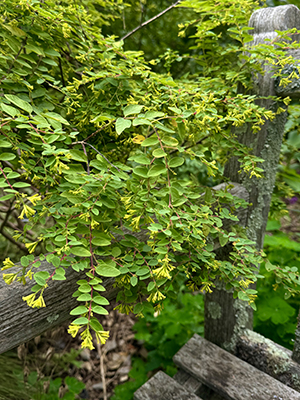
Wikstroemia trichotoma – wikstroemia
I pass by this plant every day when traipsing across campus, but most readers might not be familiar with it. Wikstroemia trichotoma, or wikstroemia, is a rare shrub in the Thymelaeaceae family (along with Daphne and Edgeworthia species). This small evergreen shrub is native to southeast China, Japan, and Korea. For the crafty readers, you might be interested to know that this is one of the plants that is historically used for making washi paper.
Sporting light green foliage on bright red twigs, this plant is eye-catching despite its small stature. Expect this shrub to grow no more than 6-8 feet, more commonly reaching 1.5-3 feet, and bloom continuously from mid-summer through the end of autumn. Blooms are dainty yellow flowers. In nature, wikstroemia grows in open forests, along roadsides, and on shrubby hills. In the garden, it’s favored for filling empty spaces and adding texture. Plant this drought-tolerant shrub anywhere that has full sun and well draining soil. Within the Scott Arboretum & Gardens, you can find Wikstroemia trichotoma outside the McCabe Library along the Parrish Circle.
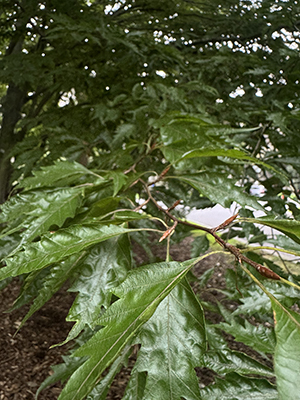
Fagus sylvatica ‘Asplenifolia’ – fernleaf European beech
Another woody feature this week – although significantly larger than the first – is Fagus sylvatica ‘Asplenifolia’, commonly known as the fernleaf European beech. This deciduous tree is a member of the Fagaceae family, along with oaks and chestnuts.
The fernleaf European beech is distinguishable by its quirky, narrowly-lobed, lanceolate leaves that are often considered fernlike (hence the nomenclature). In the spring, small yellow flowers adorn the dense oval crown, which make way for edible nuts in spiny husks in the late summer and fall. In terms of structure, Fagus sylvatica ‘Asplenifolia’ is considered a medium-sized tree, with a distinctly low-branching habit and a short trunk. Along this vein, planting this tree along a pathway or garden where the branches have room to arch and droop is a great way to add character and depth to your natural space. Fernleaf European beech is also favored for use as a woody screen or hedge feature, as it recovers well from pruning.
When considering this tree for your own space, note these things: this tree does not like to be transplanted but is slightly more tolerant of different soil types than its relative the American beech (Fagus grandifolia). In terms of pests and disease, beech trees face a number of potential pests. Beech scale is an occasional problem, identifiable by tiny, white fuzzy spots on the tree. Japanese beetles can leave the leaves skeletonized. And of course, the ever-looming threat of beech leaf disease marks these plants for death with dark-colored bands or blotches on the leaves. Within the Scott Arboretum & Gardens, you can find Fagus sylvatica ‘Asplenifolia’ within the middle planting of the West Circle (between Parrish Hall and the Outdoor Amphitheater).
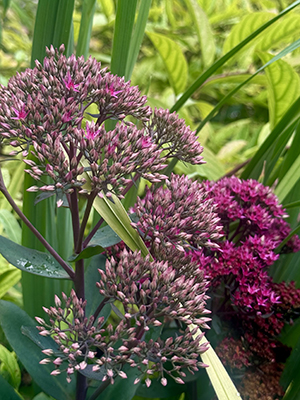
Hylotelephium ‘Thunderhead’ – stonecrop
Wrapping up this week’s featured plants is something completely different from the previous two: a xeric plant! Xeric plants are plants that are considered to be drought tolerant, usually of the cactus and succulent relation. Our spotlight this week is the Hylotelephium ‘Thunderhead’, or stonecrop, which is a hardy and deciduous perennial succulent in the Crassulaceae family. Its thick foliage and clumping growth habits give the plant the appearance of broccoli, though there is no botanical relation.
Blooming in late summer, ‘Thunderhead’ lives up to its name by displaying huge flowerheads with packed, star-shaped flowers, ranging from pink to a magenta-purple. This plant is popular for both its living and dead foliage, as the flowerheads will dry and remain on the stalks through the winter months, providing visual interest and texture to an off-season garden. Planted most commonly in beds, borders, and in gravel and rock gardens, this succulent does well with other xeric type plants that share similar care requirements. Hylotelephium is also best planted in groups, where the individual flowerheads can clump together in masses (perhaps we could call it a cumulonimbus cloud of flowerheads).
This heat-tolerant species prefers full sun and dry soils, typical for xeric-types. Altogether, this plant is fairly low maintenance, and the Hylotelephium a forgiving species. Within the Scott Arboretum and Gardens, you can find Hylotelephium ‘Thunderhead’ in the Isabella Cosby Courtyard.