
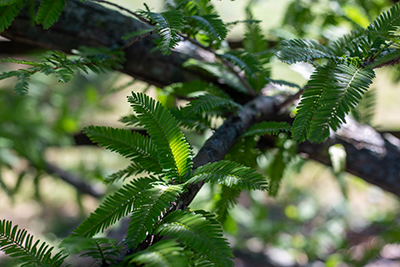
Metasequoia glyptostroboides ‘Jack Frost’ – dawn redwood
A long line of trees border the Cunningham Complex running parallel to Chester Road. This Metasequoia glyptostroboides ‘Jack Frost’ specimen nuzzles amidst the lineup. While driving along or booking it to class, the individual trees are easy to miss, losing their individuality to the screening effect. However, this dawn redwood is a delight. Fuzzy-looking leaf shoots cloak each limb as they gently bend downward before curving back up towards the light. At this time of year, tiny, immature green cones also speckle the branch tips. This particular M. glyptostroboides specimen’s shorter stature provides ample opportunity to explore the cones, branches, and leaves without having to strain your eyes or your neck on the Metasequoia allée.
Dawn redwoods have recorded fossils over 50 million years old. These towering trees tend to lean on the wetter side when it comes to soil, and their foliage shines best in the full sun. Many of the Metasequoia trees at Scott Arboretum & Gardens have beautiful shredded red bark, but on this smaller tree, that distinguishable feature hasn’t developed yet.
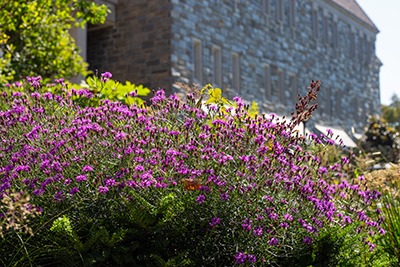
Vernonia ‘Summer Swan Song’ – narrowleaf ironweed
Outside McCabe Library, the Vernonia ‘Summer Swan Song’ is a shock of purple. Each inflorescence on the narrowleaf ironweed packs a firework of rich, fluorescent color. Each flower pops fractals into smaller trumpet-shaped flowers, disguised by their petal-like appearance. Compared to the other Vernonia species spotted across campus, the ‘Summer Swan Song’ variety is fairly small where its rounded, ball-like form falls gently beside the pathways leading to the library’s front steps. This native hybrid perennial prefers partial sun, with shade in the afternoon. Their water needs tend to be low maintenance, succeeding even in our sunny summer conditions, and it’s an excellent pollinator magnet in the early fall. Dozens of bees buzz happily between the flowers, and you might even see a butterfly or two. The plant also seems to be deer and rabbit resistant, likely due to the roughness of the thin leaves.
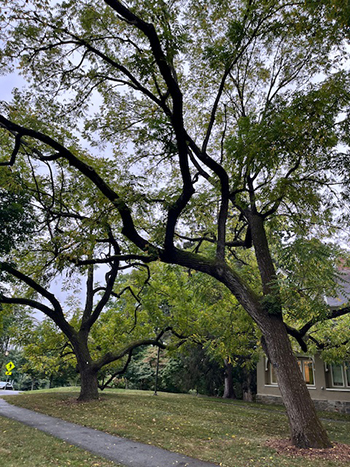
Juglans nigra – black walnut
Black walnut season has arrived. Their fruits have already started hitting the sidewalks. At Scott Arboretum & Gardens, two impressive Juglans nigra trees stretch the lawn in front of 3-5 Whittier Place. Both alike in dignity, these sun-loving trees encompass the canopy, finding cracks in each other’s sun-speckled umbrellas. The feathery leaflets allow for sunlight and to sift through to the ground level, perfect for the moist soils J. nigra prefers. At this time of year, these leaves are also streaked with occasional yellow leaflets, signalling the start of the autumnal changes.
Black walnut trees also produce juglones, chemical compounds which are specific to their genus. Juglones can be highly toxic to other plants, especially azaleas, rhododendrons, blueberries, peonies, and solanaceous crops, making J. nigra not an ideal pairing. Juglone toxicity often strays beyond the confines of the tree’s drip line after maturity and can infiltrate a larger radius over time. Keep this chemical ecological relationship in mind when planting.
While I’m not the leading expert on foraging, here are a few tips that could help a novice gathering black walnuts for the first time. Go ahead and carefully snag any walnuts you find, making sure that they still have the nuts inside if they’re cracked open on the ground already. Next, you’ll want to hull, or clean, your walnuts to get at the nuts inside. Don’t worry about fancy tools, just smash them with your feet and harvest the hardened nuts from inside. Black walnuts also produce a black, inky liquid that will get all over and stain your hands dark yellow, so do wear gloves for this part. Once you have all of your foraged, cleaned nuts, let them dry in a well-ventilated area for a few weeks to release extra moisture. Then you’ll be ready to crack open your walnuts. If you don’t have a black walnut nutcracker, a hammer should do the trick, but be careful of any flying nut pieces. You might also want to soak the nuts to help loosen the shell. After separating the shells, you’ll have your own collection of foraged black walnuts to enjoy.