
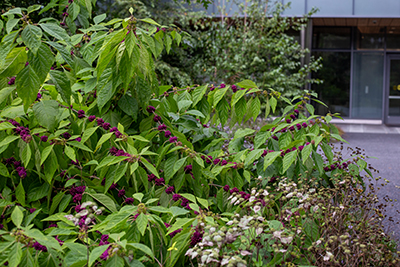
Callicarpa americana – American beautyberry
The vibrant purple berries of our Callicarpa americana have been the talk of the volunteer crews lately. They’re easy to spot from the sidewalks as you walk between Singer Hall and the John W. Nason Garden. Each outstretched branch offers bracelets of bright, violet berries. Throughout the fall, a number of bird varieties enjoy these fruit snacks, and although they’re edible for human consumption, the berries can taste bland when raw and have greater success as a jelly. Should you choose to grow your own American beautyberry plants, they are said to produce more fruits when grown near multiple Callicarpa americana plants. These perennials can also take up quite a bit of space, and they would likely make a good selection if you’re looking for a shrub to take up a sunny or partially sunny space. Maintain your plants with cutbacks in the winter for improved form. They’re less tolerant of salty conditions but are otherwise adaptable to a fair range of moist soil conditions.
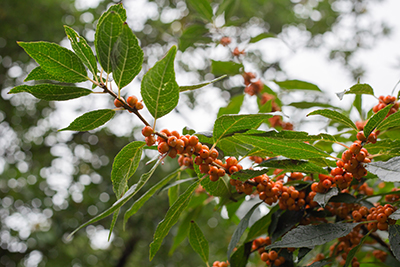
Ilex verticillata ‘Winter Gold’ – winterberry
Another very nice berry addition to the garden is the Ilex verticillata ‘Winter Gold’ in the Entrance Garden. This winterberry has already started to show off its creamsicle-colored berries that will persist through the winter months, hence the common name. For now, the drupes are nestled between leaves. However, they’ll hold down the fort through the winter. The empty branches and the cutback perennials will really give these orange eye candies their moment in the sun. As delicious as they look, Ilex fruits are poisonous to humans.
The shrub itself dons a scruffy appearance, with dozens of stems launching from the base, each one equipped with their own exuberant branches. The plants grow fairly slowly, and with proper pruning techniques, they will likely grow into whatever shape suits your garden. However, Ilex verticillata are dioecious plants, meaning they have separate male and female plants. If you want your plant to produce fruits for the winter, either plant another male plant of the same species (including different cultivars!) or pray someone in your neighborhood has their own plant to pollinate your female ‘Winter Gold’ cultivar. Winterberry also belongs to the Aquifoliaceae family, known for holly plants (Ilex) which make up a majority of the currently nonextinct plants from this family. Pollen records for Ilex date back as far as the upper Cretaceous period over 65 million years ago. Our own James R. Frorer Holly Collection features a number of different species from the Ilex genus to explore.
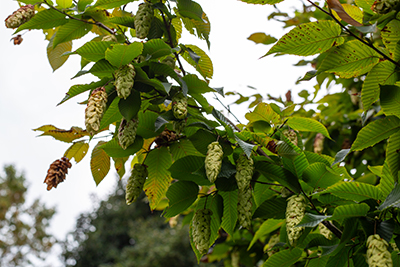
Carpinus cordata – heartleaf hornbeam
Up from the Benjamin West House, past the Biostream, and towards McCabe Library, visitors likely don’t stop to admire this unassuming tree. From spring through summer, Carpinus cordata (heartleaf hornbeam) has a lovely, dense, round shape but nothing to call home about. Its shining glory, however, are the catkins. These strands dangle from the branches, at first covered in a fuzzy display of flowers. The female catkins have since pollinated, instead dangling enticing nutlets like light-green ornaments on its autumnal branches. This tree hails from the northern latitudes of eastern Asia. There it tends to grow in forests and mountain slopes, preferring the shaded understory and moist, rich soils to the tolerable full sun. Despite the common name, the leaves don’t scream “heart-shaped.” They’re comparable to other leaves from the Carpinus genus – serrated and deep green – with just the slightest cordate impression at the petiole. This tree is also quite versatile, handling a range of soil types and light availability within Zones 5-8. On campus, our two Carpinus cordata specimens are located at the slope by the Cut Flower Display Garden and on the northern end of Whittier Parking Lot.