
Plants of the Week article written by Kaiden Lytle, education intern
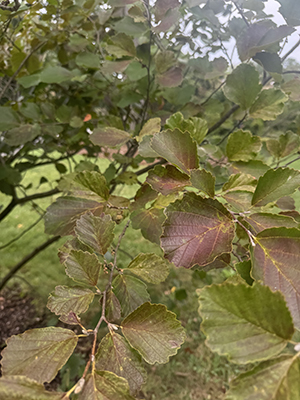
Hamamelis vernalis ‘Girard Purple’ – vernal witchhazel
Walking up the hill between the Scott Arboretum offices and the McCabe library, you might miss this small, unassuming shrub. A member of the Hamamelidaceae family, with ovate, scalloped leaves and a quirky winter-flowering habit, Hamamelis vernalis ‘Girard Purple’ isn’t your typical woody shrub. This is a vernal witchhazel.
The parent species is native to the Ozark region of Missouri, Oklahoma, and Arkansas, where it grows along rocky slopes and streambeds. During the mid- to late-winter season, vernal witchhazel produces small, fragrant flowers ranging from copper to reddish-purple before new leaves emerge. The leaves hold off until the spring, where they burst forth in shades of bronze-green, darkening to forest green as the season continues. In autumn, the leaves turn a striking golden yellow, as if giving a small preview to the further winter color to come in the colder months.
Though this shrub can be modest in appearance, it has striking moments throughout several seasons and adds a level of depth to the winter months of a year-round garden, when color is usually lacking. Used by gardeners for hedges, screens, and woodland gardens, this is truly a great, underutilized woody plant.
Baptisia australis – false indigo
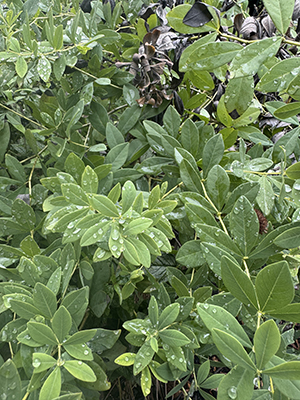
The next featured plant comes with a science lesson. As a small to medium height, bushy perennial, false indigo (Baptisia australis) is another interesting, though unassuming, plant. Because it is a member of the pea family, Baptisia australis has a really cool relationship with microorganisms in the plant’s root system called rhizobia. The microorganisms inhabit nodules within the root system, where they produce the nitrogen compounds required for the plant’s survival and growth. All plants in the pea family, Fabaceae, have these beneficial microorganisms in their root systems.
Moving above ground, Baptisia australis has an eyecatching flowering habit in mid summer, where it boasts blue-purple clusters of flowers on dense, upright spikes. The flower shape is very reminiscent of other flowering pea-family members. Its silvery foliage also provides a nice backdrop for other flowering plants, and its wide branching habits further this. In late summer, the large dried pods provide unique adornment/interest in a garden, as well as a food source for foraging birds. In autumn, the foliage dies and the remaining stalks’ color leeches to a dry silver, providing some interest in regards to form and structure in a garden’s “off” season.
Preferred by gardeners for native plant gardens, stormwater gardens, pollinator gardens, and cottage gardens, this plant has a notable deep taproot, and is hard to move once established. Within the Scott Arboretum & Gardens, you can find Baptisia australis within the Piedmont Meadow, Whittier Meadow, and outside the Dining and Community Commons in the stormwater basins.
Malus ‘JFS-KW5’ – Royal Raindrops® crabapple
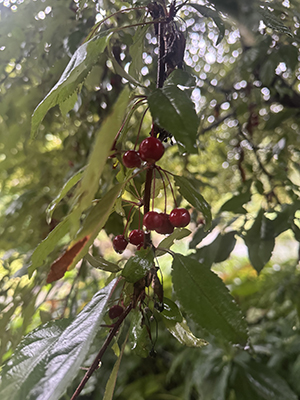
Lastly this week is the largest of the three specimens: Malus ‘JFS-KW5’, known familiarly as Royal Raindrops® crabapple. It is an easy cultivar to grow, and was bred specifically for disease resistance and fall color. It is an open-pollinated seedling of Malus transitoria ‘Schmidtcutleaf’. At maturity, the tree has a dense and rounded crown shape, and is extremely drought tolerant once established. The foliage of Royal Raindrops® crabapple is green-purple and deeply lobed, turning an attractive orange-red in autumn, and sporting small maroon crabapples.
An interesting fact about crabapples in general, is that the fruit often stays on the tree well into winter, providing a food source for birds and other wildlife. In the spring, the tree is adorned with small magenta flowers. Pruning should only be done in late winter to reduce the risk of fire blight. In gardens and greenscapes, Royal Raindrops® crabapple is fairly versatile, favored for specimen or accent trees, or as a small group planting of multiple individuals. Within the Scott Arboretum & Gardens, this plant can be found beside the fish pond in the Terry Shane Teaching Garden and outside the south side of Wharton Hall.