

The saddleback caterpillar is stunningly beautiful, but it is most likely to impress its presence upon you with a devilish sting. If you innocently brush against one where it hangs on the underside of a leaf, you will be punished with an intensely burning welt for several minutes at least. Perhaps you can forgive its cruelty as you marvel at its vivid color and otherworldly form.
The caterpillar’s common name refers to the brown, saddle-like blotch in the center of its rich kelly green back. Each end is capped with reddish-brown and bears a pair of imposing bristly “horns.” The head is moustachioed with additional spines and the tail end bears large white eye spots reminiscent of spiderman’s. Both sides of the abdomen are lined with yet more spines.
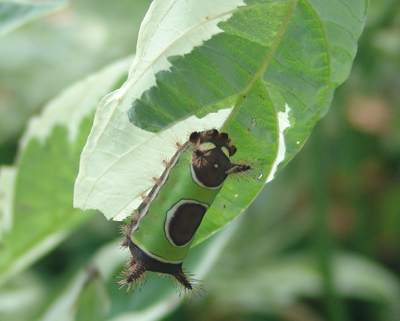
Saddleback capterpillar photo credit: N. Lewis
The saddleback caterpillar is the larva of a fairly inconspicuous brown moth. The species, Acharia stimulea (formerly Sibine stimulea), is native to the eastern United States. You are most likely to encounter the caterpillar in August and September. I have found them on roses, Itea, shrub dogwoods, and Carex, but they are documented to feed on dozens of common garden plants.